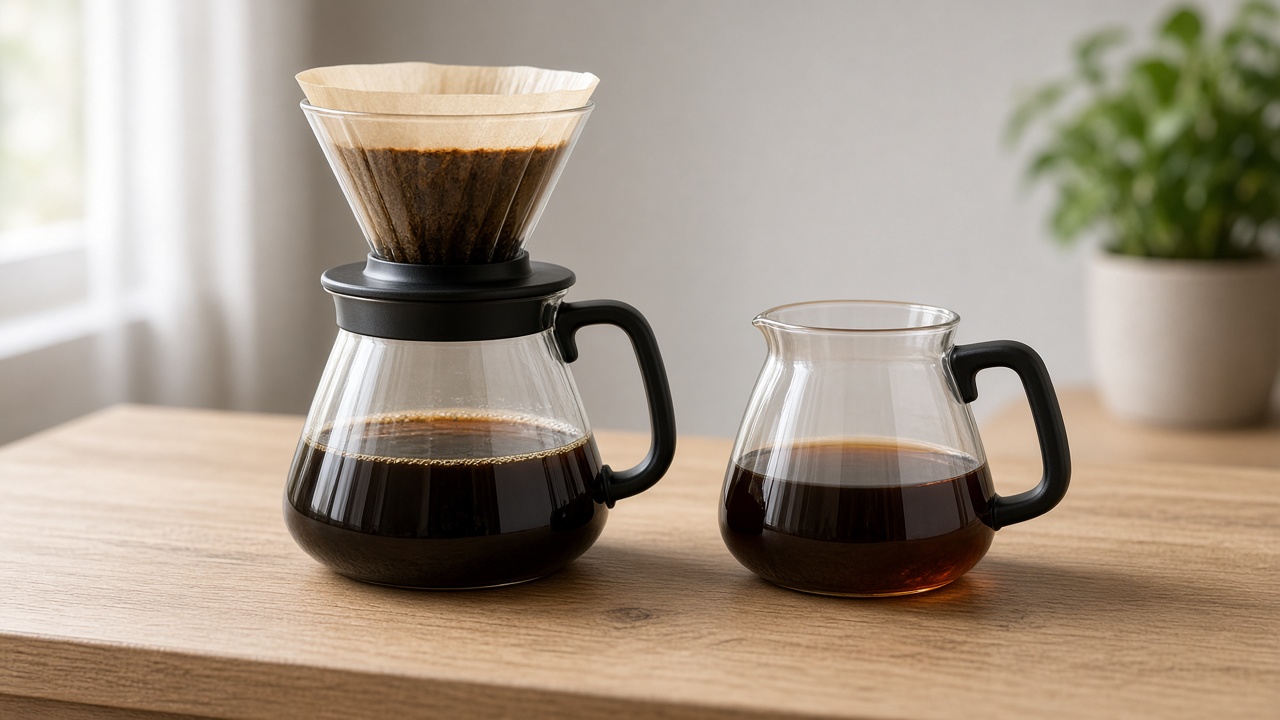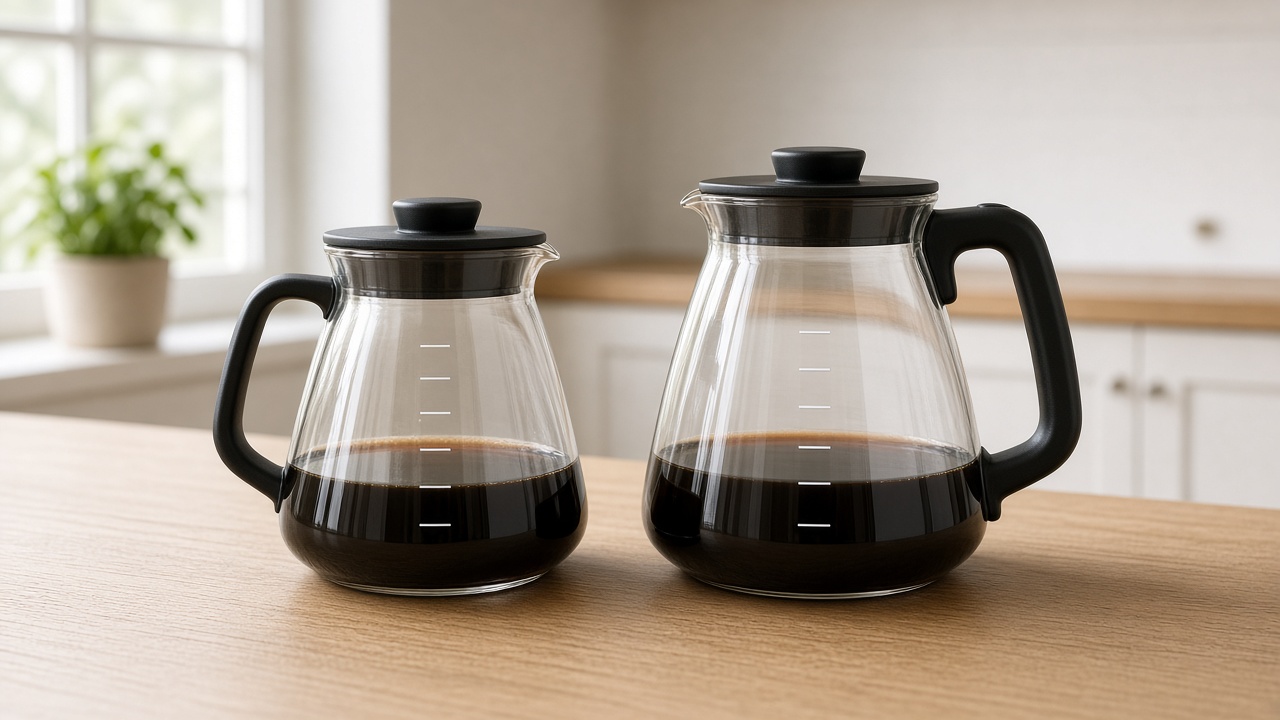
Category: Coffee Gear

Japanese pour-over drippers and hand grinders compared using official specs.

  • Hario V60 Glass Coffee Server 01 vs 02: Which Size to Buy?

    Hario V60 Glass Coffee Server 01 vs 02: Which Size to Buy?

    As an Amazon Associate, TidyJapan earns from qualifying purchases. Links marked ‘Check price’ are affiliate links.

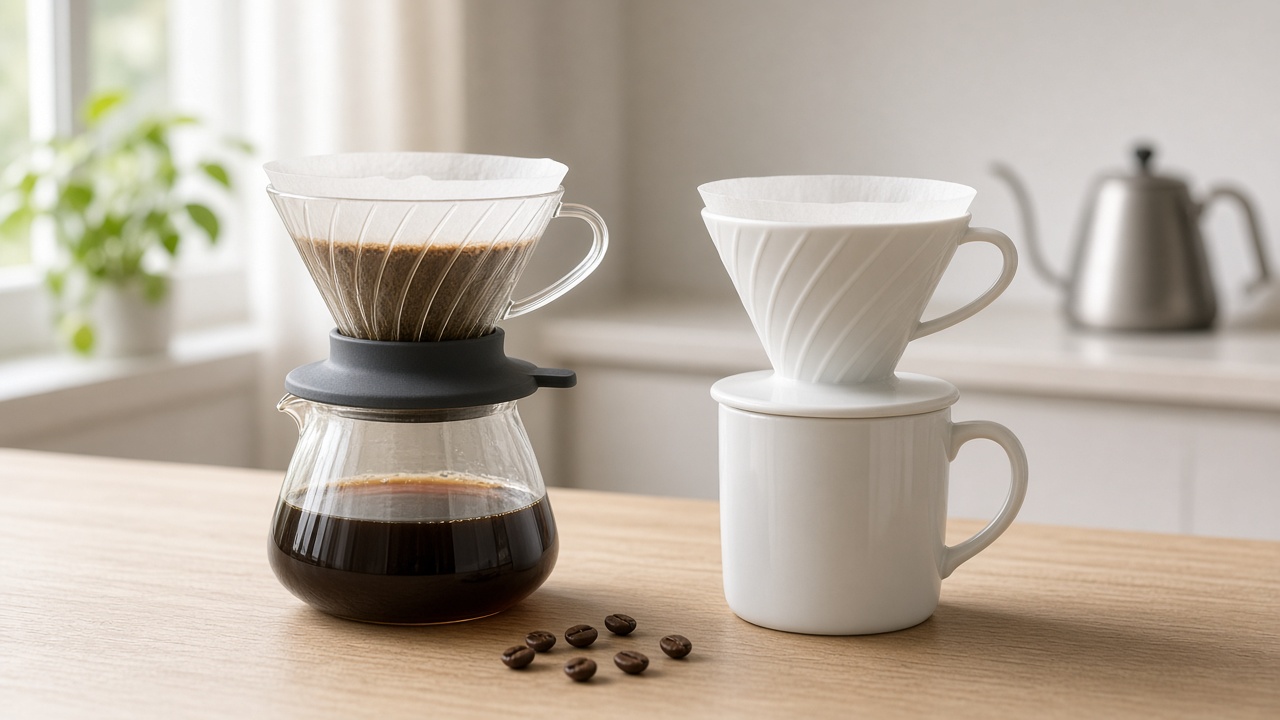
    Short answer: Choose the Hario V60 Glass Coffee Server 01 (VCS-01B, 450 mL practical capacity) for everyday single pour-overs and a compact Japan-made glass carafe at $15.50 on Hario USA when we checked. Choose the 02 (VCS-02B, 700 mL) if you want more headroom for a larger mug, sharing, or a V60 size-02 dripper—$17.00 on Hario USA. Both use a heatproof glass bowl with a polypropylene lid/handle (silicone bushing on USA/global specs), share a 92 mm opening on Hario Japan’s size table, and are marked for hot water, microwave, and dishwasher on Hario Japan’s care icons. Hario USA says microwave safe with or without the lid. A larger 03 (VCS-03B, 1,000 mL) exists for big batches.

    How we compare: every spec and price below comes from Hario’s official pages we fetched (Hario USA’s V60 Glass Coffee Server page, Hario Japan’s V60コーヒーサーバー page, global.hario.com VCS, and HARIO NETSHOP)—all listed under Sources. We don’t run hands-on brew tests. Where we summarize Japanese third-party blogs, we say so. Last updated: November 2026.

    This guide compares sizes inside the handled Glass Coffee Server line only (VCS-01B vs VCS-02B, with a short official note on VCS-03B). It complements—not replaces—our Glass Coffee Server vs Range Server article, which contrasts product styles rather than 01 vs 02 capacity.

    Quick Comparison Table

    Spec Glass Coffee Server 01 Glass Coffee Server 02
    Hario USA product page V60 Glass Coffee Server (shared page) Same shared page
    Product number VCS-01B VCS-02B
    Hario USA SKU HR-VCS-01B HR-VCS-02B
    Hario USA price $15.50 $17.00
    Practical capacity (Hario) 450 mL 700 mL
    Size (W × D × H) 162 × 114 × 110 mm (6.4 × 4.5 × 4.3 in) 180 × 125 × 133 mm (7.1 × 4.9 × 5.2 in)
    Opening (JP / global) 口径 / Φ 92 mm 口径 / Φ 92 mm
    Weight with box (JP / global) About 300 g (10.6 oz) About 400 g (14.1 oz)
    Color (official JP) Black (ブラック) Black (ブラック)
    Glass bowl Heatproof glass (borosilicate / HARIO Glass®) Same
    Lid & handle Polypropylene Same
    Bushing (USA / global) Silicone rubber Same
    Made in Japan Japan
    Care (Hario Japan icons) Hot water, microwave, dishwasher marked possible; oven, IH, open fire not marked possible Same
    Hario USA microwave note Microwave safe with or without the lid Same
    Japan MSRP (tax incl.) ¥1,210 ¥1,320
    Japanese name V60コーヒーサーバー 450 V60コーヒーサーバー 700

    U.S. prices, SKUs, product numbers, capacities, sizes, materials, Made in Japan, microwave note, and features from Hario USA’s shared V60 Glass Coffee Server page, checked November 6, 2026, when 01/02/03 were all listed as available. Opening diameter, Japanese names, Japan MSRP, weights with box, HARIO Glass® wording, and care icons from Hario Japan / HARIO NETSHOP / global.hario.com. Inch conversions are ours from Hario’s mm figures. Silicone bushing from Hario USA and global.hario.com material lists (Hario Japan’s material line on this page lists glass + polypropylene lid/handle).

    Key differences at a glance

    • Practical capacity: 01 = 450 mL; 02 = 700 mL (Hario: capacity below the handle band).
    • Footprint: 02 is wider, deeper, and taller (180 × 125 × 133 mm vs 162 × 114 × 110 mm).
    • Weight with box: about 300 g (01) vs about 400 g (02).
    • Hario USA price: $15.50 (01) vs $17.00 (02) when we checked.
    • Same on both: black handled design, 92 mm opening (JP), heatproof glass + PP lid/handle, Japan-made; JP icons mark hot water / microwave / dishwasher possible.

    1. Capacity and who should buy which

    Hario rates these carafes by practical capacity below the handle band: 450 mL (01) and 700 mL (02). That is not the same labeling system as V60 drippers (“1–2 cups” / “1–4 cups”). For dripper servings, Hario’s V60 manuals commonly treat one serving as about 120 mL—useful context, but the server pages themselves publish milliliters.

    Hario USA also notes measurement lines on the glass, a handle for pouring, and that the lid can sit upside down to catch drips from a V60 dripper. Shoppers usually pair server 01 with dripper 01 and server 02 with dripper 02 so the stack and brew volume feel matched.

    Choose Glass Coffee Server 01 (VCS-01B) if you:

    • Mostly brew one smaller pour-over (often with a V60 01 dripper)
    • Want the lighter, more compact carafe (about 300 g with box)
    • Prefer the lower Hario USA price ($15.50 when we checked)

    Choose Glass Coffee Server 02 (VCS-02B) if you:

    • Brew into a larger mug, a small shared pot, or regularly use a V60 02 dripper
    • Want 700 mL of practical capacity and don’t mind a taller carafe (about 400 g with box)
    • Are fine at $17.00 on Hario USA when we checked

    Optional 03 note (official only): VCS-03B is 1,000 mL practical capacity (185 × 137 × 157 mm; about 500 g with box; Japan MSRP ¥1,430 tax included; Hario USA $18.50 available when we checked). Pick 03 for larger batches—not the default for most home 01/02 setups.

    2. Price and availability

    On Hario USA’s shared V60 Glass Coffee Server page (November 6, 2026):

    • 01 / HR-VCS-01B / VCS-01B: $15.50, available
    • 02 / HR-VCS-02B / VCS-02B: $17.00, available
    • 03 / HR-VCS-03B / VCS-03B: $18.50, available (side note)

    Japan manufacturer’s suggested retail prices on hario.com (tax included): ¥1,210 (01), ¥1,320 (02), ¥1,430 (03). HARIO NETSHOP’s vcs-01b product handle listed all three variants available at those prices the same day. Amazon and other retailers may differ—use the Check price buttons and confirm VCS-01B or VCS-02B on the listing.

    3. Care and microwave notes

    Hario Japan’s product icons for the V60 Glass Coffee Server:

    • Marked possible: hot water (熱湯), microwave (電子レンジ), dishwasher (食洗機)
    • Not marked possible: oven, IH, open fire

    Hario USA’s description states the server is microwave safe with or without the lid. Materials on Hario USA / global pages: heatproof (borosilicate) glass bowl, polypropylene lid and handle, silicone rubber bushing. Hario Japan describes the glass as HARIO Glass® made in a domestic factory from natural materials, with a polypropylene lid/handle set.

    We queried U.S. SaferProducts.gov recall data for “Hario” and for “V60” on November 6, 2026 and did not find a recall for Hario V60 glass coffee servers (name matches in a broad “Hario” pull were unrelated “Chariot*” products). CPSC HTML search endpoints returned Access Denied from our fetch environment; SaferProducts.gov was the working official U.S. recall API we used.

    A View from Japan

    In Japan the line is sold as V60コーヒーサーバー. Hario’s Japanese product page lists black (ブラック) VCS-01B / VCS-02B / VCS-03B with practical capacity below the handle band, a shared 92 mm opening, Japan origin, and the care icons above. Suggested retail prices (tax included) match HARIO NETSHOP: ¥1,210 / ¥1,320 / ¥1,430.

    Item Japan (HARIO official)
    Japanese name V60コーヒーサーバー
    Official model codes VCS-01B (450 mL); VCS-02B (700 mL); VCS-03B (1,000 mL)
    NETSHOP / Japan MSRP (tax incl.) 01 ¥1,210; 02 ¥1,320; 03 ¥1,430
    Capacity wording 実用容量(バンド下)— practical capacity below the handle band
    Opening 口径92mm on all three sizes (hario.com)
    Material (hario.com) Glass bowl: heatproof HARIO Glass®; lid & handle band set: polypropylene
    Bushing (global.hario.com / Hario USA) Silicone rubber
    Made in Japan (日本製)
    Care icons (hario.com) Hot water, microwave, and dishwasher marked possible; oven, IH, and open fire not marked possible

    Japanese names, MSRP, sizes, opening, weights, materials, origin, and care icons from Hario Japan / HARIO NETSHOP / global.hario.com, checked November 6, 2026.

    Japanese reviewers often start with capacity and how the server stacks with a V60 dripper. A long-term Japanese review of the VCS-01B (450 mL) notes that the lid is shaped so a V60 dripper can sit on top, that the handle texture echoes the V60 dripper, and that the glass has measurement markings the writer describes in cup-style increments (including a 120 mL-oriented scale). Another Japanese buyer log comparing 01 and 02 servers says size is obvious once you look at them side by side, that people who only brew for one cup-sized serving can stay on 01, and that many regular home brewers are better served by the 02 unless they specifically want the smaller 01—while also warning not to confuse the handled Coffee Server (700 mL on 02) with Hario’s separate Range Server style. (Third-party reviews, not our own testing.)

    Hario V60 Glass Coffee Server 01 vs 02: Frequently Asked Questions

    Should I buy the Hario V60 Glass Coffee Server 01 or 02?

    Buy the 01 (VCS-01B, 450 mL practical capacity) if you mostly brew one modest pour-over—especially with a V60 size-01 dripper—and want the smaller footprint and lower Hario USA price ($15.50 when we checked). Buy the 02 (VCS-02B, 700 mL) if you brew into a larger mug, share a pot, or use a V60 size-02 dripper and want the extra headroom at $17.00 on Hario USA. Both are Japan-made heatproof glass with a polypropylene lid/handle; Hario USA says microwave safe with or without the lid.

    How do the mL capacities relate to Hario’s Japanese cups?

    Hario lists these servers by practical capacity in milliliters (450 / 700 / 1,000 mL below the handle band)—not as “1–2 cups” the way V60 drippers are rated. For dripper sizing, Hario’s V60 manual treats one serving as about 120 mL. So 450 mL is roughly enough volume for several small Japanese-cup servings in theory, but shoppers usually match server number to dripper number (01 server with 01 dripper, 02 with 02). We do not invent a cup rating Hario does not print on the server pages.

    Is this the same as the Hario V60 Range Server?

    No. This article is about the handled V60 Glass Coffee Server line (VCS-01B / VCS-02B / VCS-03B). Hario also sells a separate Range Server style (different shape/handle family and capacities such as 600 mL on common 02-oriented listings). For that product-line comparison, see our Glass Coffee Server vs Range Server guide linked below—this page is a size comparison within the handled Coffee Server line only.

    Are the V60 Glass Coffee Servers microwave and dishwasher safe?

    Hario Japan’s care icons mark hot water (熱湯), microwave (電子レンジ), and dishwasher (食洗機) as possible, and do not mark oven, IH, or open fire as possible. Hario USA’s product copy separately says the server is microwave safe with or without the lid. Follow Hario’s manual for heat and handling limits; do not use oven, IH, or open fire.

    What about the 03 size (VCS-03B)?

    Hario also lists VCS-03B at 1,000 mL practical capacity (185 × 137 × 157 mm; about 500 g with box; Japan MSRP ¥1,430 tax included; Hario USA $18.50 when we checked, available). Choose 03 only if you regularly brew larger batches than 700 mL. Most home V60 01/02 setups stay with 01 or 02.

    Where are they made, and how much do they cost?

    Hario USA, Hario Japan, and Hario Global list the line as made in Japan. Checked November 6, 2026 on Hario USA’s shared V60 Glass Coffee Server page: 01 $15.50, 02 $17.00, 03 $18.50—all available. Japan MSRP on hario.com / HARIO NETSHOP (tax included): ¥1,210 / ¥1,320 / ¥1,430, with all three variants available on the NETSHOP product handle that day. Amazon prices can differ—use the Check price buttons.

    Check current listings

    Amazon results for “Hario V60 coffee server” often mix the handled Glass Coffee Server (VCS), Range Server models, olive-wood handle servers, ceramic dripper sets, and size 03. Confirm VCS-01B (450 mL) or VCS-02B (700 mL)—or the Hario USA SKU HR-VCS-01B / HR-VCS-02B—on the product page before buying.

    Also listed (larger size side note): Glass Coffee Server 03 (VCS-03B / 1000 mL).

    Sources

    Specs and prices checked November 6, 2026 (Asia/Tokyo). We found no U.S. SaferProducts.gov recall for Hario V60 glass coffee servers when we checked. Prices and availability change, so verify the current listing and model number before buying.
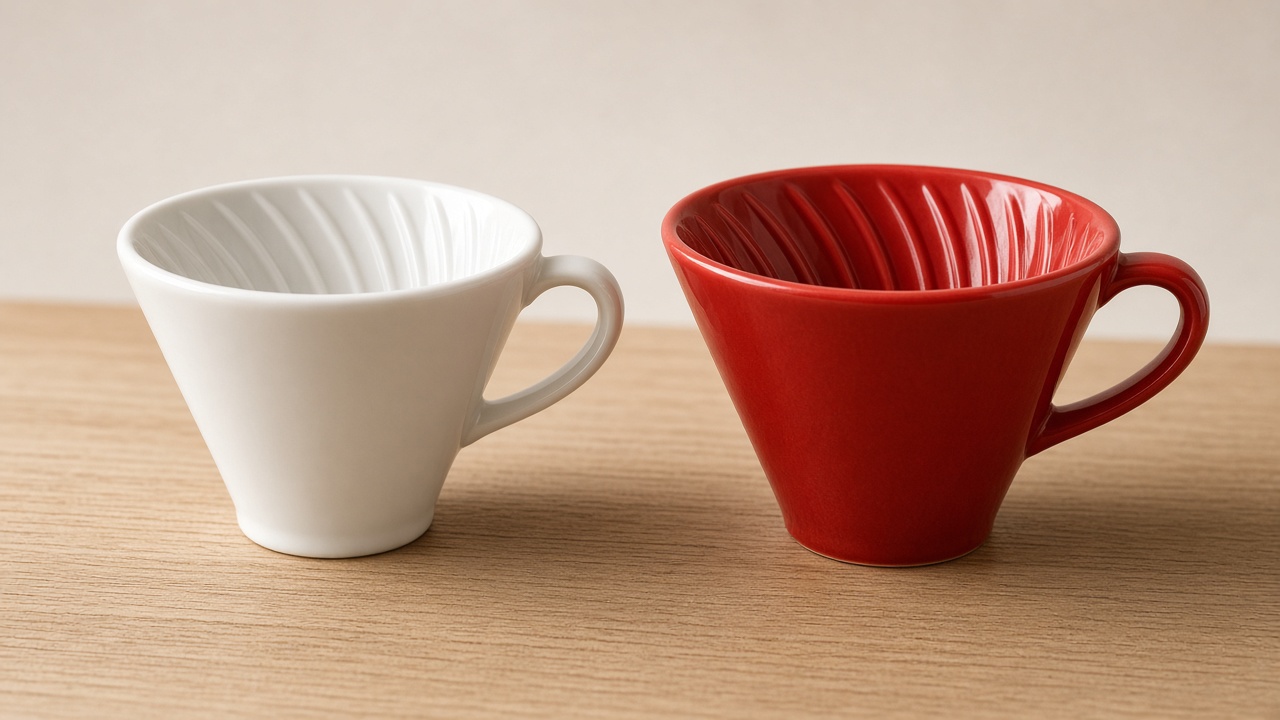
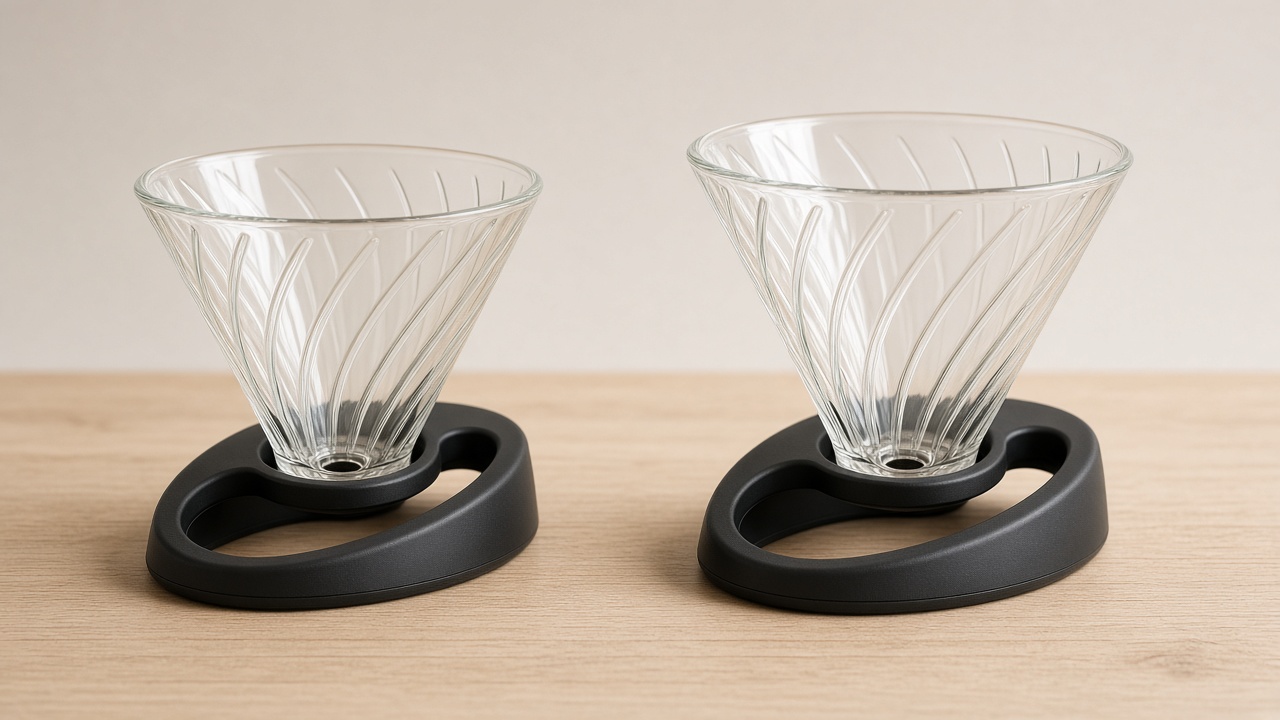
  • Hario V60 Ceramic Dripper 01 vs 02: Which Size to Buy?

    Hario V60 Ceramic Dripper 01 vs 02: Which Size to Buy?

    As an Amazon Associate, TidyJapan earns from qualifying purchases. Links marked ‘Check price’ are affiliate links.

    Short answer: Choose the Hario V60 Ceramic Dripper 01 (classic White VDC-01-W / Red VDCR-01-R) for everyday 1–2 Japanese-cup brews (about 120–240 mL). Choose the 02 (classic White VDC-02W / Red VDC-02R; Japan codes VDCR-02-W / VDCR-02-R) if you want Hario’s 1–4 Japanese-cup rating (up to about 480 mL). At Hario USA’s Classic Colors listings, 01 is $27.50 and 02 is $30.50 White / $32.50 Red; all were available when we checked. Match filters to size. Both are Japan-made Arita-yaki porcelain; Hario Japan marks hot water and dishwasher as possible, and does not mark microwave, oven, IH, or open fire as possible.

    How we compare: every spec and price below comes from Hario’s official pages we fetched (starting with Hario USA’s Ceramic 01 Classic Colors page, Hario USA’s Ceramic 02 Classic Colors page, Hario Japan’s V60透過ドリッパー セラミック page, global.hario.com VDC, and HARIO NETSHOP), plus Hario’s V60 manual for the 120 mL cup note—all listed under Sources. We don’t run hands-on brew tests. Where we summarize Japanese third-party blogs, we say so. Last updated: November 2026.

    This guide compares classic white/red ceramic sizes only: Hario’s Arita-yaki porcelain V60 01 vs 02. It complements our plastic size guide, plastic-vs-ceramic 02 guide, and glass 01 vs 02 guide rather than replacing them. If you already know you want plastic or glass, use those articles; if you want porcelain and need the cup size, stay here.

    Quick Comparison Table

    Spec Ceramic 01 (classic White/Red) Ceramic 02 (classic White/Red)
    Hario USA product page V60 Ceramic Dripper 01 – Classic Colors V60 Ceramic Dripper 02 – Classic Colors
    Hario USA SKUs HR-VDC-01W (White); HR-VDCR-01-R (Red) HR-VDC-02W (White); HR-VDC-02R (Red)
    Product numbers on Hario USA VDC-01-W / VDCR-01-R VDC-02W / VDC-02R
    Japan / global model codes VDCR-01-W / VDCR-01-R VDCR-02-W / VDCR-02-R
    Hario USA price (classic) $27.50 (White or Red) $30.50 White; $32.50 Red
    Capacity (Hario) 1–2 Japanese cups 1–4 Japanese cups
    Approx. brew range (Hario 120 mL cup) About 120–240 mL (4–8 fl oz) About 120–480 mL (4–16 fl oz)
    Size (W × D × H) 119 × 100 × 82 mm (4.7 × 3.9 × 3.2 in), Φ95 mm 140 × 120 × 102 mm (5.5 × 4.7 × 4.0 in), Φ116 mm
    Weight with box (official JP/global) About 300 g (10.6 oz) About 400 g (14.1 oz)
    Matching paper filters V60 01 filters (e.g. VCF-01) V60 02 filters (e.g. VCF-02)
    Body Porcelain (Arita-yaki / 有田焼 per Hario) Same
    Made in Japan Japan
    Care (Hario Japan icons) Hot water and dishwasher marked possible; microwave, oven, IH, open fire not marked possible Same
    Japan MSRP (tax incl.) ¥2,750 ¥3,080
    Japanese name V60透過ドリッパー セラミック 01 V60透過ドリッパー セラミック 02

    U.S. prices, SKUs, product numbers, Arita-yaki / handmade copy, materials, Made in Japan, sizes, and capacities from Hario USA Classic Colors pages, checked November 5, 2026, when all classic White/Red options above were listed as available. Dimensions with Φ, Japanese names, Japan MSRP, weights with box, and care icons from Hario Japan / HARIO NETSHOP / global.hario.com. Inch and fl oz conversions, and the 120–240 / 120–480 mL ranges, are ours from Hario’s mm figures and 120 mL cup definition. Filter size pairing from Hario’s V60 paper-filter pages.

    Key differences at a glance

    • Brew size: 01 = 1–2 Japanese cups; 02 = 1–4 Japanese cups (Hario’s cup ≈ 120 mL).
    • Footprint: 02 is wider, deeper, and taller (140 × 120 × 102 mm vs 119 × 100 × 82 mm) with a wider cone opening (Φ116 mm vs Φ95 mm).
    • Weight with box: about 300 g (01) vs about 400 g (02).
    • Hario USA classic price: $27.50 (01 either color) vs $30.50 White / $32.50 Red (02).
    • Filters: 01 papers vs 02 papers—match the number on the dripper.
    • Same on both: porcelain body described as Arita-yaki, made in Japan; Hario Japan marks hot water / dishwasher possible and does not mark microwave, oven, IH, or open fire as possible.

    1. Size and Japanese Cups

    Hario USA lists capacity as 1–2 Cups for ceramic 01 and 1–4 Cups for ceramic 02, and the same pages label that capacity system as Japanese cups in the broader V60 lineup context. That “Japanese cup” is much smaller than many U.S. mug servings. Hario’s official V60 instruction manual states that one serving is 120 mL, with about 10–12 g of coffee as a guide per serving. HARIO NETSHOP’s ceramic V60 size table also prints ※1杯=120ml.

    Using that official 120 mL figure:

    • 01: about 120–240 mL (roughly 4–8 fl oz)—typically one smaller cup or a modest single mug.
    • 02: about 120–480 mL (roughly 4–16 fl oz)—room for a large mug, a small server pour, or two smaller cups.

    Physical size from Hario: 01 is 119 × 100 × 82 mm with a 95 mm opening; 02 is 140 × 120 × 102 mm with a 116 mm opening. Packed weight is about 300 g vs 400 g.

    2. Arita-yaki porcelain (classic colors)

    Hario USA’s classic ceramic pages say the drippers are made from Arita-yaki, “a traditional style of Japanese ceramics with a 400 year history,” and that each dripper is handmade by a local craftsperson. Materials are listed as porcelain; origin is Japan. Hario Japan’s ceramic V60 page uses the same craft story in Japanese (有田焼き / handmade) and lists the body as 磁器 (porcelain).

    This article focuses on the classic White and Red colors. Side note only (official pages we fetched): Hario USA also lists a metallic-finish ceramic 01 page (Gold / Silver / Pearl at $45 when we checked; that page says those finishes are not microwave or dishwasher safe and that the finish is applied in Taiwan) and a “New Colors” ceramic 02 page at $35 with multiple glaze options. We did not find a live Classic-adjacent “New Colors” 01 page at the URL that previously appeared in search results (it returned 404 when we checked), so we are not listing unverified 01 fashion colors here.

    3. Paper Filters

    Hario’s V60 paper-filter pages state that the papers are for Hario V60 drippers and tell you to confirm dripper size and paper size before use. In practice that means:

    White vs natural-brown filter paper is a separate choice; see our filter-color comparison linked below.

    4. Price and Availability

    On Hario USA Classic Colors pages (November 5, 2026):

    • 01 White (HR-VDC-01W) / 01 Red (HR-VDCR-01-R): $27.50, available
    • 02 White (HR-VDC-02W): $30.50, available
    • 02 Red (HR-VDC-02R): $32.50, available

    Japan manufacturer’s suggested retail prices on hario.com (tax included): ¥2,750 (01 White or Red) and ¥3,080 (02 White or Red). HARIO NETSHOP listed VDCR-01-W, VDCR-01-R, VDCR-02-W, and VDCR-02-R in stock at those prices the same day (shared product handle vdc-02w). Amazon and other retailers may differ—use the Check price buttons and confirm the model number and color on the listing.

    5. Care and Safety

    Hario Japan’s product icons for the ceramic V60:

    • Marked possible: hot water (熱湯) and dishwasher (食洗機)
    • Not marked possible: microwave, oven, IH, open fire

    Treat it as a pour-over dripper that sits on a mug or server—not cookware for a stove or microwave. Separately, Hario USA’s metallic ceramic 01 page warns that those metallic finishes are not microwave or dishwasher safe.

    We searched U.S. SaferProducts.gov recall data for “Hario” and for “V60” on November 5, 2026 and did not find a recall for Hario V60 ceramic drippers (name matches in a broad “Hario” pull were unrelated “Chariot*” products). CPSC HTML search endpoints returned blocked responses from our fetch environment; SaferProducts.gov was the working official U.S. recall API we used.

    Who Should Buy Which?

    Choose Ceramic 01 if you:

    • Usually brew one smaller cup or a modest single mug (Hario 1–2 cups / about 120–240 mL)
    • Want the more compact porcelain cone (about 300 g with box; Φ95 mm)
    • Prefer the lower Hario USA classic price ($27.50 when we checked)

    Choose Ceramic 02 if you:

    • Sometimes brew for two or into a larger mug/server (Hario 1–4 cups / up to about 480 mL)
    • Want the wider, taller cone (Φ116 mm; about 400 g with box)
    • Are fine paying about $3–$5 more at Hario USA ($30.50 White / $32.50 Red when we checked)

    Still deciding porcelain vs plastic for size 02 only? See our plastic-vs-ceramic 02 guide linked below. Still deciding glass vs ceramic? Use the glass 01 vs 02 guide for clear heatproof glass sizing, then come back here for porcelain sizing.

    A View from Japan

    In Japan the line is sold as V60透過ドリッパー セラミック (HARIO NETSHOP also titles it V60透過ドリッパー(磁器製)). Hario’s Japanese product page describes the classic V60 cone, large single hole, and spiral ribs, and states that the material is Japanese Arita-yaki porcelain with each piece handmade. Official capacities are written as 1–2杯用 (01) and 1–4杯用 (02)—the same Japanese-cup system as the U.S. listings, with Hario’s manual defining one cup/serving as 120 mL and NETSHOP printing ※1杯=120ml on the ceramic size table.

    Item Japan (HARIO official)
    Japanese name V60透過ドリッパー セラミック / V60透過ドリッパー(磁器製)
    Official model codes VDCR-01-W / VDCR-01-R; VDCR-02-W / VDCR-02-R
    NETSHOP / Japan MSRP (tax incl.) 01 ¥2,750; 02 ¥3,080 (White and Red same on NETSHOP)
    Cup wording 01 = 1–2杯用; 02 = 1–4杯用
    Hario “1 cup” 120 mL per cup in the official V60 manual; NETSHOP ceramic size table prints ※1杯=120ml
    Material / craft note (hario.com / Hario USA) Porcelain (磁器); Hario says Arita-yaki with ~400 years of history, each dripper handmade by a craftsperson
    Made in Japan
    Care icons (hario.com) Hot water and dishwasher marked possible; microwave, oven, IH, and open fire not marked possible

    Japanese names, MSRP, sizes, weights, materials, origin, Arita-yaki craft note, and care icons from Hario Japan / HARIO NETSHOP / global.hario.com, checked November 5, 2026. Cup = 120 mL from the official V60 manual and Hario’s ceramic V60 NETSHOP size note.

    Japanese reviewers often treat size (01 / 02 / 03) as the first decision and material second. A Japanese Hario-focused lineup guide notes that ceramic V60 drippers use Arita-yaki (except separate Noritake collaboration models), describes ceramic as having a more premium look for long-term ownership, and groups ceramic with glass for higher heat retention when preheated, while calling out that ceramic is heavier and more breakable than plastic. A Japanese lifestyle review focused on the glass 02 still gives a practical size rule many shoppers reuse across materials: choose 01 when you only brew into a normal coffee cup for one person, and 02 when you also brew into something around a larger tumbler. (Third-party reviews, not our own testing.)

    Hario V60 Ceramic Dripper 01 vs 02: Frequently Asked Questions

    Should I buy the Hario V60 Ceramic Dripper 01 or 02?

    Buy ceramic 01 if you mostly brew one mug within Hario’s 1–2 Japanese-cup rating (about 120–240 mL). Buy ceramic 02 if you sometimes brew for two, fill a larger mug or server, or want Hario’s 1–4 Japanese-cup rating (up to about 480 mL). Classic white/red prices at Hario USA when we checked: 01 $27.50; 02 White $30.50 / Red $32.50. Match filters to size (01 papers with 01, 02 papers with 02). Both are Japan-made Arita-yaki porcelain on Hario’s classic ceramic line.

    What does Hario mean by 1–2 cups and 1–4 cups?

    Hario rates these drippers in Japanese cups, not typical U.S. mug sizes. The official V60 manual treats one serving as 120 mL (about 4 fl oz), with 10–12 g of coffee as a guide per serving. HARIO NETSHOP’s ceramic V60 size table also prints ※1杯=120ml. So 01’s 1–2 cups is roughly 120–240 mL, and 02’s 1–4 cups is roughly 120–480 mL—our multiplication from Hario’s 120 mL figure.

    Do ceramic 01 and 02 use the same paper filters?

    No. Hario’s V60 paper-filter pages say to match dripper size and paper size. Use 01 papers (for example VCF-01, labeled 1–2 cups) with the 01 dripper, and 02 papers (for example VCF-02, labeled 1–4 cups) with the 02 dripper.

    What is Arita-yaki, and is the ceramic V60 handmade?

    Hario USA and Hario Japan both describe the ceramic V60 body as Arita-yaki (有田焼)—a traditional Japanese porcelain style Hario says has about 400 years of history—and state that each dripper is handmade by a craftsperson. Official material wording is porcelain / 磁器, made in Japan.

    Why do Hario USA and Japan use different-looking model codes?

    On Japan and global pages the classic colors are listed as VDCR-01-W / VDCR-01-R and VDCR-02-W / VDCR-02-R. Hario USA’s Classic Colors pages list product numbers VDC-01-W / VDCR-01-R for size 01 and VDC-02W / VDC-02R for size 02, with store SKUs HR-VDC-01W, HR-VDCR-01-R, HR-VDC-02W, and HR-VDC-02R. Same classic white/red ceramic line—read both the color and the 01/02 size before buying.

    Are Hario V60 ceramic drippers microwave or dishwasher safe?

    Hario Japan’s care icons for the ceramic V60 mark hot water and dishwasher as possible, and do not mark microwave, oven, IH, or open fire as possible. Treat it as a pour-over dripper on a mug or server—not microwave or stovetop cookware. (Hario USA’s separate metallic-finish ceramic 01 page separately says those metallic finishes are not microwave or dishwasher safe.)

    Where are they made, and how much do they cost?

    Hario USA, Hario Japan, and Hario Global list the classic ceramic drippers as porcelain made in Japan. Checked November 5, 2026 on Hario USA Classic Colors: 01 White/Red $27.50 available; 02 White $30.50 and 02 Red $32.50, both available. Japan MSRP on hario.com / HARIO NETSHOP: 01 ¥2,750 and 02 ¥3,080 tax included (all four classic White/Red SKUs in stock on NETSHOP that day). Amazon prices can differ—use the Check price buttons.

    Check current listings

    Amazon results for “Hario V60 ceramic dripper” often mix plastic (VDR), glass (VDGR / VDG), metallic or new-color ceramic finishes, size 03, Immersion Switch ceramic models, and filter-only listings. Confirm classic 01 or 02 porcelain with White/Red (or the exact USA SKU / Japan VDCR code you want) on the product page before buying.

    Also listed: 01 paper filters; 02 paper filters.

    Sources

    Specs and prices checked November 5, 2026 (Asia/Tokyo). We found no U.S. SaferProducts.gov recall for Hario V60 ceramic drippers when we checked. Prices and availability change, so verify the current listing and model number before buying.
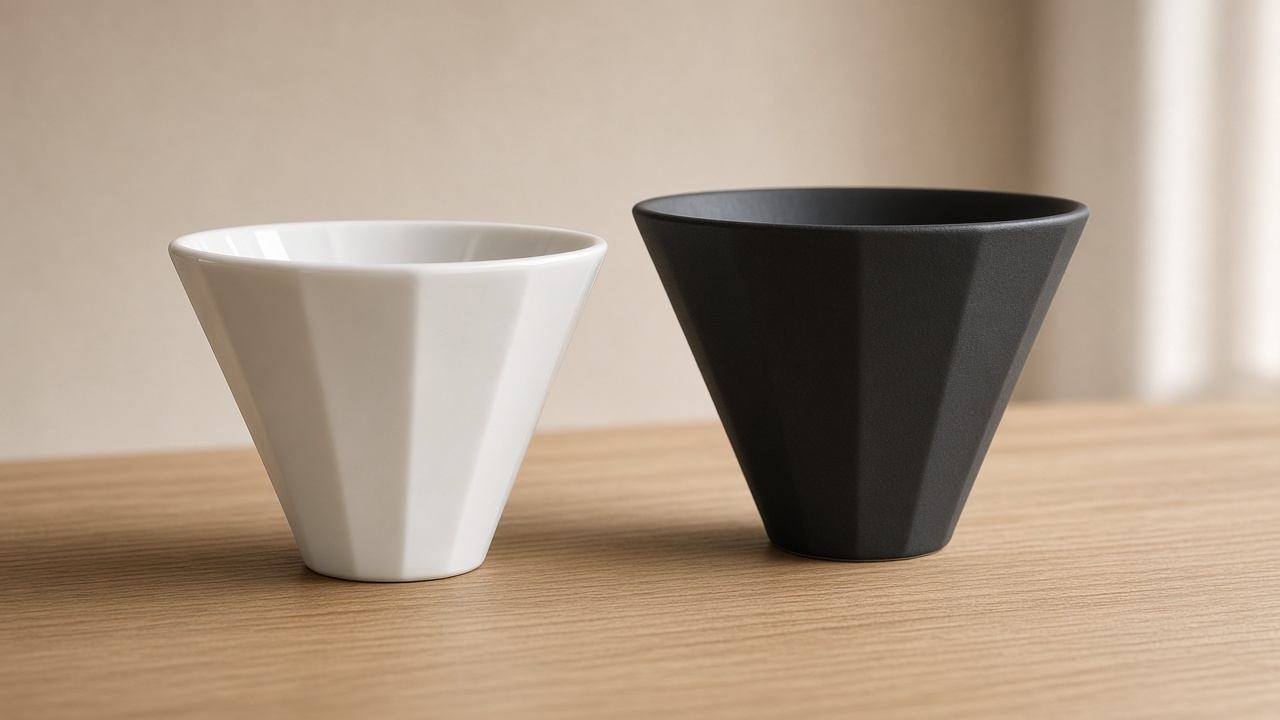
  • Hario V60 Glass Dripper 01 vs 02: Which Size to Buy?

    Hario V60 Glass Dripper 01 vs 02: Which Size to Buy?

    As an Amazon Associate, TidyJapan earns from qualifying purchases. Links marked ‘Check price’ are affiliate links.

    Short answer: Choose the Hario V60 Glass Dripper 01 (VDGR-01-B) for everyday 1–2 Japanese-cup brews (about 120–240 mL). Choose the 02 (VDGR-02-B) if you want Hario’s 1–4 Japanese-cup rating (up to about 480 mL) for larger mugs or two servings. At Hario USA’s New Oval Base listing, 01 is $23.50 and 02 is $26.50; both were in stock when we checked. Match filters to size (01 papers with 01, 02 papers with 02). Both are Japan-made heatproof glass with a polypropylene oval base, dishwasher- and hot-water-safe, and not for microwave, oven, or open fire.

    How we compare: every spec and price below comes from Hario’s official pages we fetched (starting with Hario USA’s New Oval Base glass V60 page, Hario Japan’s V60 耐熱ガラス透過ドリッパー page, global.hario.com VDGR, and HARIO NETSHOP), plus Hario’s V60 manual for the 120 mL cup note—all listed under Sources. We don’t run hands-on brew tests. Where we summarize Japanese third-party blogs, we say so. Last updated: November 2026.

    This guide compares the current glass sizes on Hario’s New Oval Base line: VDGR-01-B vs VDGR-02-B. It complements our plastic size guide and plastic-vs-ceramic 02 guide rather than replacing them. If you already know you want plastic or ceramic, use those articles; if you want clear heatproof glass and need the cup size, stay here.

    Quick Comparison Table

    Spec Glass 01 (VDGR-01-B) Glass 02 (VDGR-02-B)
    Hario USA product line V60 Glass Coffee Dripper – New Oval Base Same product page (size option)
    USA SKU HR-VDGR-01-B HR-VDGR-02-B
    Hario USA price $23.50 $26.50
    Capacity (Hario) 1–2 Japanese cups 1–4 Japanese cups
    Approx. brew range (Hario 120 mL cup) About 120–240 mL (4–8 fl oz) About 120–480 mL (4–16 fl oz)
    Size (W × D × H) 138 × 97 × 77 mm (5.4 × 3.8 × 3.0 in), Φ97 mm 138 × 115 × 95 mm (5.4 × 4.5 × 3.7 in), Φ115 mm
    Weight with box (official JP/global) About 200 g (7.1 oz) About 300 g (10.6 oz)
    Matching paper filters V60 01 filters (e.g. VCF-01) V60 02 filters (e.g. VCF-02)
    Body Heatproof borosilicate glass (HARIO Glass® on JP pages) Same
    Holder / base Polypropylene; new hollow-oval base (Hario USA) Same
    Made in Japan Japan
    Care (Hario USA) Hot water and dishwasher OK; not for open fire, microwave, or oven Same
    Japan MSRP (tax incl.) ¥1,980 ¥2,200
    Japanese name V60 耐熱ガラス透過ドリッパー 01 V60 耐熱ガラス透過ドリッパー 02

    U.S. prices, SKUs, New Oval Base description, materials, Made in Japan, and care from Hario USA (hario-usa.com/products/vdgr-01-b), checked November 4, 2026, when both size options were listed as available. Dimensions, Japanese names, Japan MSRP, weights with box, and care icons from Hario Japan / HARIO NETSHOP / global.hario.com. Inch and fl oz conversions, and the 120–240 / 120–480 mL ranges, are ours from Hario’s mm figures and 120 mL cup definition. Filter size pairing from Hario’s V60 paper-filter pages.

    Key differences at a glance

    • Brew size: 01 = 1–2 Japanese cups; 02 = 1–4 Japanese cups (Hario’s cup ≈ 120 mL).
    • Footprint: same 138 mm width; 02 is deeper and taller (115 × 95 mm vs 97 × 77 mm) with a wider cone opening (Φ115 mm vs Φ97 mm).
    • Weight with box: about 200 g (01) vs about 300 g (02).
    • Hario USA price: $23.50 vs $26.50 on the shared New Oval Base page.
    • Filters: 01 papers vs 02 papers—match the number on the dripper.
    • Same on both: heatproof glass body, polypropylene oval-base holder, made in Japan, hot water / dishwasher OK; not for microwave, oven, or open fire per Hario USA.

    1. Size and Japanese Cups

    Hario USA lists capacity as 1–2 Japanese Cups for VDGR-01-B and 1–4 Japanese Cups for VDGR-02-B. That “Japanese cup” is much smaller than many U.S. mug servings. Hario’s official V60 instruction manual states that one serving is 120 mL, with about 10–12 g of coffee as a guide per serving. HARIO NETSHOP’s V60 ceramic dripper size table also prints ※1杯=120ml.

    Using that official 120 mL figure:

    • 01: about 120–240 mL (roughly 4–8 fl oz)—typically one smaller cup or a modest single mug.
    • 02: about 120–480 mL (roughly 4–16 fl oz)—room for a large mug, a small server pour, or two smaller cups.

    Physical size from Hario: both are 138 mm wide; 01 is 97 mm deep × 77 mm high with a 97 mm opening, while 02 is 115 mm deep × 95 mm high with a 115 mm opening. Packed weight is about 200 g vs 300 g.

    2. New Oval Base (and older base styles)

    Hario USA’s copy for this listing says the version features a newly designed base “sort of shaped like a hollow oval” so you can more clearly see the fill level of a mug or server. Hario Japan’s VDGR page makes the same design point: the dripper is meant to make the coffee volume easier to see even in opaque thermal mugs or servers.

    Hario USA still lists a separate Clover Base glass dripper page with item VDG-02B (1–4 cups, $27.50 when we checked) and size 03 as VDGN-03B. The 2025 coffee catalog and Japan/global pages focus on the current VDGR-01-B / VDGR-02-B (and VDGN-03-B) glass numbers. If you are shopping used or marketplace listings, read the model stamp carefully so a clover-base VDG-02B is not confused with oval-base VDGR-02-B.

    3. Paper Filters

    Hario’s V60 paper-filter pages state that the papers are for Hario V60 drippers and tell you to confirm dripper size and paper size before use. In practice that means:

    White vs natural-brown filter paper is a separate choice; see our filter-color comparison linked below.

    4. Price and Availability

    On Hario USA’s New Oval Base page (November 4, 2026):

    • 01 / Black (HR-VDGR-01-B): $23.50, available
    • 02 / Black (HR-VDGR-02-B): $26.50, available

    Japan manufacturer’s suggested retail prices on hario.com (tax included): ¥1,980 (01) and ¥2,200 (02). HARIO NETSHOP listed both VDGR-01-B and VDGR-02-B in stock at those prices the same day. Amazon and other retailers may differ—use the Check price buttons and confirm the model number on the listing.

    5. Care and Safety

    Hario USA for the New Oval Base glass dripper:

    • Safe for hot water and dishwasher
    • Not safe for open fire, microwave, or oven

    Hario Japan’s product icons for VDGR mark hot water and dishwasher as possible, and do not mark microwave, oven, IH, or open fire as possible. Treat it as a pour-over dripper that sits on a mug or server—not cookware for a stove or microwave.

    We searched U.S. CPSC / SaferProducts.gov recall data for Hario and for Hario V60 dripper-related titles on November 4, 2026 and did not find a recall for Hario V60 drippers (name matches in a broad “Hario” pull were unrelated “Chariot*” products).

    Who Should Buy Which?

    Choose Glass 01 (VDGR-01-B) if you:

    • Usually brew one smaller cup or a modest single mug (Hario 1–2 cups / about 120–240 mL)
    • Want the lighter, more compact cone (about 200 g with box; Φ97 mm)
    • Prefer the lower Hario USA price ($23.50 when we checked)

    Choose Glass 02 (VDGR-02-B) if you:

    • Sometimes brew for two or into a larger mug/server (Hario 1–4 cups / up to about 480 mL)
    • Want the wider, taller cone (Φ115 mm; about 300 g with box)
    • Are fine paying about $3 more at Hario USA ($26.50 when we checked)

    Need batches beyond 02? Hario’s glass 03 (VDGN-03-B) is rated 1–6 cups on official Japan/global pages (Amazon search: Hario V60 Glass Dripper 03 VDGN-03).

    A View from Japan

    In Japan the line is sold as V60 耐熱ガラス透過ドリッパー. Hario’s Japanese product page describes a heatproof-glass dripper with the classic V60 cone, large single hole, and spiral ribs, and notes a base design that makes brew volume easier to see in opaque thermal mugs or servers. Official capacities are written as 1–2杯用 (01) and 1–4杯用 (02)—the same Japanese-cup system as the U.S. “Japanese Cups” label, with Hario’s manual defining one cup/serving as 120 mL.

    Item Japan (HARIO official)
    Japanese name V60 耐熱ガラス透過ドリッパー (VDGR-01-B / VDGR-02-B)
    NETSHOP / Japan MSRP (tax incl.) 01 ¥1,980; 02 ¥2,200 (VDGN-03-B ¥2,310)
    Cup wording 01 = 1–2杯用; 02 = 1–4杯用; 03 = 1–6杯用
    Hario “1 cup” 120 mL per cup in the official V60 manual; also listed as ※1杯=120ml on Hario’s V60 ceramic NETSHOP size table
    Design note (hario.com) Cone, large single hole, spiral ribs; base designed so brew level is easier to see in opaque thermal mugs or servers
    Materials Body: heatproof glass “HARIO Glass®”; holder: polypropylene
    Made in Japan
    Care icons (hario.com) Hot water and dishwasher marked possible; microwave, oven, IH, and open fire not marked possible

    Japanese names, MSRP, sizes, weights, materials, origin, and care icons from Hario Japan / HARIO NETSHOP / global.hario.com, checked November 4, 2026. Cup = 120 mL from the official V60 manual and Hario’s ceramic V60 NETSHOP size note.

    Japanese reviewers often choose 01 vs 02 by everyday cup size rather than by glass vs plastic. On a Japanese lifestyle blog reviewing the glass 02 (VDGR-02), the writer suggests 01 when you only brew into a normal coffee cup for one person, and 02 when you also brew into something around a 360 mL tumbler; the same review repeats Hario’s cone / large hole / spiral-rib story and notes that pour speed strongly changes strength until you get used to the fast drain. A Japanese Hario-focused guide that lists current glass model numbers (including VDGR-01 / VDGR-02 and VDGN-03) treats size 01/02/03 as the first decision, then material; for glass it highlights heat retention if you preheat, while noting breakage risk as the trade-off. (Third-party reviews, not our own testing.)

    Hario V60 Glass Dripper 01 vs 02: Frequently Asked Questions

    Should I buy the Hario V60 Glass Dripper 01 or 02?

    Buy 01 (VDGR-01-B) if you mostly brew one mug at a time within Hario’s 1–2 Japanese-cup rating (about 120–240 mL). Buy 02 (VDGR-02-B) if you sometimes brew for two, fill a larger mug or server, or want Hario’s 1–4 Japanese-cup rating (up to about 480 mL). Both share the New Oval Base glass/PP build, Japan origin, and the same care rules; 02 costs $3 more at Hario USA ($26.50 vs $23.50 when we checked).

    What does Hario mean by 1–2 cups and 1–4 cups?

    Hario rates these drippers in Japanese cups, not typical U.S. mug sizes. The official V60 manual treats one serving as 120 mL (about 4 fl oz), with 10–12 g of coffee as a guide per serving. So 01’s 1–2 cups is roughly 120–240 mL, and 02’s 1–4 cups is roughly 120–480 mL—our multiplication from Hario’s 120 mL figure, not a separate Hario volume stamp on the dripper.

    Do 01 and 02 use the same paper filters?

    No. Hario’s V60 paper-filter pages say to match dripper size and paper size. Use 01 papers (for example VCF-01, labeled 1–2 cups) with the 01 dripper, and 02 papers (for example VCF-02, labeled 1–4 cups) with the 02 dripper.

    What is the New Oval Base, and how is it different from the Clover Base?

    On Hario USA, the current VDGR-01-B / VDGR-02-B listing is titled “V60 Glass Coffee Dripper – New Oval Base.” Hario USA describes a newly designed hollow-oval base that makes the fill level easier to see in an opaque mug or server. A separate Hario USA listing, “V60 Glass Coffee Dripper – Clover Base,” still shows older-style item VDG-02B (1–4 cups, $27.50 when we checked) and size 03 as VDGN-03B. Do not mix model numbers: oval-base 01/02 are VDGR-*; the clover-base 02 page uses VDG-02B.

    Is there a glass V60 03?

    Yes. Hario lists V60 Glass Dripper 03 as VDGN-03-B for 1–6 cups (about 165 × 138 × 115 mm, Φ136 mm, about 400 g with box; Japan MSRP ¥2,310). It uses a different article prefix (VDGN) from the oval-base 01/02 (VDGR). On Hario USA it appeared on the Clover Base product page as VDGN-03B at $30.50 when we checked.

    Are Hario V60 glass drippers microwave or dishwasher safe?

    Hario USA says the New Oval Base glass dripper is hot water and dishwasher safe, and not safe for open fire, microwave, or oven. Hario Japan’s care icons for VDGR mark hot water and dishwasher as possible, and do not mark microwave, oven, IH, or open fire as possible.

    Where are they made, and how much do they cost?

    Hario USA, Hario Japan, and Hario Global list the glass body with polypropylene holder as made in Japan. Checked November 4, 2026 on Hario USA: 01 $23.50 and 02 $26.50, both available. Japan MSRP on hario.com / HARIO NETSHOP: 01 ¥1,980 and 02 ¥2,200 tax included (both in stock on NETSHOP that day). Amazon prices can differ—use the Check price buttons.

    Check current listings

    Amazon results for “Hario V60 glass dripper” often mix plastic (VDR), ceramic (VDCR), older clover-base glass (VDG), olive-wood bases (VDGR-*-OV), size 03 (VDGN), and filter-only listings. Confirm VDGR-01-B or VDGR-02-B (New Oval Base) on the product page before buying.

    Also listed: Glass 03 (VDGN-03-B); 01 paper filters; 02 paper filters.

    Sources

    Specs and prices checked November 4, 2026 (Asia/Tokyo). We found no U.S. CPSC recall for Hario V60 drippers when we checked. Prices and availability change, so verify the current listing and model number before buying.
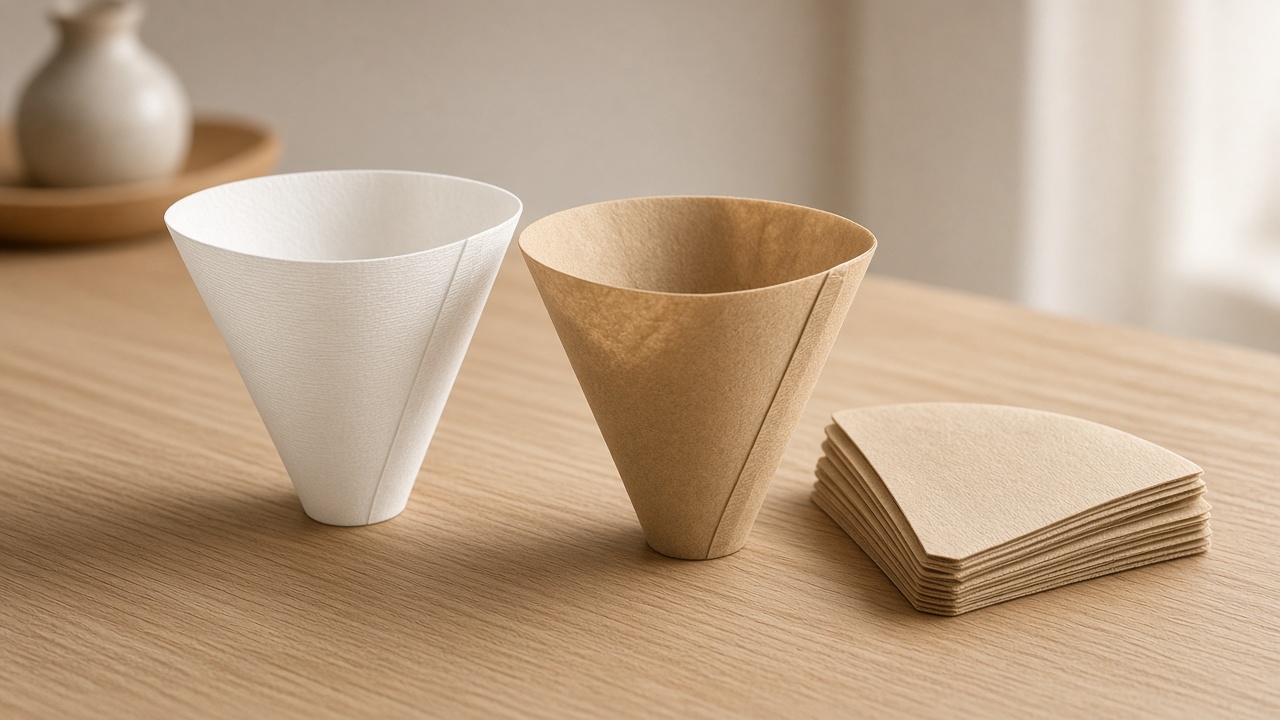
  • KINTO OCT Brewer 2 Cups vs 4 Cups: Which Size to Buy?

    KINTO OCT Brewer 2 Cups vs 4 Cups: Which Size to Buy?

    As an Amazon Associate, TidyJapan earns from qualifying purchases. Links marked ‘Check price’ are affiliate links.

    Short answer: Get the KINTO OCT Brewer 2 Cups (28881) if you brew for one or two people, and the 4 Cups (28882) if you often brew for three or four. Both are the same porcelain, handle-free cone dripper made in Japan, and both are dishwasher safe. KINTO USA sells them for $23.70 and $26.30. The 4 Cups is larger (130 vs 115 mm wide) and heavier (about 280 vs 230 g). KINTO’s matching OCT jugs mark 2 cups at 300 ml and 4 cups at 600 ml.

    How we compare: every spec and price in this article comes from KINTO’s official pages (starting with KINTO USA’s 2 Cups page and KINTO Japan’s product page), all listed under Sources below. We don’t run hands-on tests. Where we quote what people found when brewing, they are Japanese testers and reviewers, and we say so. Last updated: November 2026.

    KINTO is a Japanese tableware brand, and OCT is its coffee series built around an octagon. The OCT brewer is a porcelain cone dripper with sharp, faceted sides and a wide, curved rim instead of a handle. It comes in two sizes, 2 Cups and 4 Cups, and two colors, white and black. Apart from size, the two brewers share the same design, material and care instructions, so the choice comes down to how much coffee you brew and which jug and filters you want to pair with it.

    Quick Comparison Table

    Spec OCT Brewer 2 Cups OCT Brewer 4 Cups
    Model numbers 28881 (white) / 28891 (black) 28882 (white) / 28892 (black)
    KINTO USA price $23.70 $26.30
    Size (W x D x H) 115 x 100 x 90 mm (4.6 x 4.0 x 3.6 in) 130 x 110 x 105 mm (5.2 x 4.4 x 4.2 in)
    Weight (KINTO Japan) About 230 g (8.1 oz) About 280 g (9.9 oz)
    Material Porcelain Porcelain
    Handle None (wide curved rim to hold) None (wide curved rim to hold)
    Dishwasher safe Yes Yes
    Made in Japan Japan
    Matching OCT jug 300 ml / 10 oz jug (28887), $13.70 600 ml / 24 oz jug (28888), $16.50
    KINTO cone filter in the same size SCS cotton paper filter 2cups (27633), 60 for $5.20 SCS cotton paper filter 4cups (27634), 60 for $6.60
    Japan price (tax incl.) ¥2,200 ¥2,420

    Sizes, materials, care and U.S. prices from KINTO USA’s official online store (kinto-usa.com), checked November 2, 2026, when both sizes were listed in both colors. Weights and Japanese prices (tax included) from KINTO Japan’s official store (kinto.co.jp). Ounce and inch conversions are ours. No electricity cost applies: this is a manual pour-over dripper.

    Key differences at a glance

    • Batch size: 2 Cups pairs with a 300 ml jug; 4 Cups pairs with a jug marked at 300 ml and 600 ml.
    • Size: 2 Cups is 115 x 100 x 90 mm (4.6 x 4.0 x 3.6 in); 4 Cups is 130 x 110 x 105 mm (5.2 x 4.4 x 4.2 in).
    • Weight: about 230 g (8.1 oz) vs about 280 g (9.9 oz).
    • Price: $23.70 vs $26.30 at KINTO USA, a $2.60 difference.
    • Same on both: porcelain, no handle, wide curved rim, dishwasher safe, made in Japan, white or black.

    1. How Much Coffee Each Size Makes

    KINTO rates the brewers by cups and doesn’t print a ml figure for the drippers themselves. The clearest guide is the matching glassware. KINTO’s OCT coffee jug 300 ml has a single mark at 300 ml, and the OCT coffee jug 600 ml has marks at 300 ml and 600 ml. KINTO Japan labels those marks as the guide for 2 cups (300 ml) and 4 cups (600 ml).

    So in KINTO’s terms, one “cup” is about 150 ml (5 oz). That works out to roughly:

    • 2 Cups (28881): up to about 300 ml (10 oz), one large mug or two small cups
    • 4 Cups (28882): up to about 600 ml (20 oz), three to four small cups or two large mugs

    These ml figures are our reading of KINTO’s jug marks, not a brewer spec. If you mostly fill a 12 oz (355 ml) travel mug, the 2 Cups size is on the small side, and the 4 Cups gives you room to spare. Our KINTO Travel Tumbler 350ml vs 500ml guide covers KINTO’s travel mugs.

    2. Size and Weight

    The 4 Cups is 15 mm (about 0.6 in) wider and 15 mm taller than the 2 Cups, and about 50 g (1.8 oz) heavier, according to KINTO’s figures. Both are small enough for most kitchen shelves. The 2 Cups is the better pick if you want to leave the brewer out on display in a small space. KINTO notes that size and shape vary slightly from piece to piece because of the manufacturing process.

    Porcelain is heavier than plastic, and it can chip or break if dropped. If you’re choosing between porcelain and plastic in general, our Hario V60 02 Plastic vs Ceramic guide covers the trade-offs.

    3. Design: Octagon Facets and No Handle

    Both sizes share the same design. KINTO USA describes it this way: “The brewer draws a large beautiful curve. It is designed so that it can be held easily without a handle, and placing and removing the paper filter is simple.” KINTO Japan’s series page says the whole OCT line is based on an octagon (八角形), with sharp straight lines and small details meant to make brewing and drinking comfortable.

    White and black are the same brewer in two colors. The model numbers are 28881 and 28891 (2 Cups), and 28882 and 28892 (4 Cups). KINTO lists both colors at the same price.

    4. Matching Jugs and Filters

    KINTO sells one OCT coffee jug for each brewer size. Both jugs are heat-resistant glass, made in China, and microwave and dishwasher safe.

    OCT coffee jug Fits with KINTO USA price Size Full capacity KINTO’s marks
    300 ml / 10 oz (28887) Brewer 2 Cups $13.70 ø85 x H85 x W125 mm (ø3.4 x H3.4 x W5.0 in) 400 ml (13.6 oz) One mark at 300 ml (2 cups)
    600 ml / 24 oz (28888) Brewer 4 Cups $16.50 ø95 x H115 x W145 mm (ø3.8 x H4.6 x W5.8 in) 700 ml (23.8 oz) Marks at 300 ml (2 cups) and 600 ml (4 cups)

    From KINTO USA (checked November 2, 2026) and KINTO Japan. The “full capacity” is the jug filled to the brim, more than the coffee it is meant to hold. Conversions are KINTO’s.

    For paper, KINTO’s OCT pages don’t name a specific filter. KINTO’s own cone-shaped paper filters, the SCS cotton paper filter 2cups and 4cups, come in the same two sizes. KINTO USA says the cotton and wood pulp paper “filters fine coffee powders to bring out a clear, mild taste.” No glue is used on the seam, so KINTO says to fold the paper along the seam before you place it in the brewer, or the seam may open.

    5. Total Cost

    Setup 2 Cups 4 Cups
    Brewer only $23.70 $26.30
    Brewer + matching OCT jug $37.40 $42.80
    Brewer + jug + 60 KINTO filters $42.60 $49.40
    Cost per KINTO filter About 9¢ About 11¢

    Our math from KINTO USA prices, checked November 2, 2026. Shipping and tax not included.

    Even with the jug and a pack of filters, the gap between the two setups is under $7. So price shouldn’t decide it. Pick by how much you brew at once.

    Who Should Buy Which?

    Choose the OCT Brewer 2 Cups (28881 / 28891) if you:

    • Usually brew one mug or two small cups at a time
    • Want the smaller, lighter brewer (about 230 g) to keep on display
    • Plan to pair it with the 300 ml OCT jug

    Choose the OCT Brewer 4 Cups (28882 / 28892) if you:

    • Often brew for three or four people, or brew two large mugs at once
    • Fill a 12 oz or larger travel mug most mornings
    • Want the 600 ml OCT jug, which is marked at both 2 and 4 cups

    A View from Japan

    In Japan, KINTO sells these as OCT ブリューワー 2cups and OCT ブリューワー 4cups. KINTO Japan’s OCT series page explains the name: the series is built on an octagon (八角形, “Octagon”). The brewers sell for ¥2,200 and ¥2,420, tax included, and KINTO Japan lists them as porcelain, dishwasher safe and made in Japan. The same 2cups and 4cups naming runs through the matching jugs and KINTO’s cotton paper filters, which makes it easy to keep a set the same size.

    Item Japan (KINTO official)
    Japanese names OCT ブリューワー 2cups / OCT ブリューワー 4cups
    What “OCT” means Short for octagon (八角形); the whole series is designed around an eight-sided shape
    Price (tax incl.) 2cups ¥2,200; 4cups ¥2,420
    Weight 2cups about 230 g; 4cups about 280 g
    Material and care 磁器 (porcelain), 食洗機使用可 (dishwasher safe), 日本製 (made in Japan)
    Matching jugs OCT コーヒージャグ 2cups ¥1,320; 4cups ¥1,540 (heat-resistant glass, made in China)
    KINTO cone filters SCS コットンペーパーフィルター 2cups ¥550; 4cups ¥715 (60 sheets each)

    Japanese names, prices and specs from KINTO Japan’s official store (kinto.co.jp), checked November 2, 2026. Prices include Japanese consumption tax.

    KINTO Japan’s own journal offers a simple starting recipe. In an interview about pour-over tips, the coffee shop LIGHT UP COFFEE, with shops in Tokyo’s Shimokitazawa and Kichijoji, used the OCT Brewer 2cups and OCT jug 2cups. Its barista suggests using a scale, pouring water at 16 times the weight of the coffee grounds, and aiming for about 3 minutes until the coffee stops dripping. They praised the OCT jug’s glass handle as clean and easy to use.

    Japanese reviewers mostly comment on the design and on how fast it drains. A Japanese home-goods blog brewed one cup in nine drippers, including the KINTO OCT, using each dripper’s size recommended for one cup, 12 g of coffee, 92°C water and a 150 ml target. All the paper cone drippers, the OCT among them, reached the target in about 1 minute 20 seconds, and the testers said the differences were within the margin of error. On Rakuten, the OCT brewer and jug set in the 4-cup size averages 4.75 stars from four reviews. Buyers praise the design and the jug’s handle; one said it drips faster than they expected, and another found the taste fairly clean. A Japanese coffee site that ranked KINTO drippers put the OCT second, praising its looks while noting that porcelain is weak to impacts and needs careful handling. (Third-party reviews, not our own testing.)

    KINTO OCT Brewer 2 Cups vs 4 Cups: Frequently Asked Questions

    Should I buy the KINTO OCT brewer in 2 cups or 4 cups?

    Buy the 2 Cups (28881) if you usually brew for one or two people, and the 4 Cups (28882) if you often brew for three or four. KINTO’s own OCT jugs put the 2-cup mark at 300 ml (about 10 oz) and the 4-cup mark at 600 ml (about 20 oz), which is a good guide to what each size is meant to brew. The 4 Cups costs only $2.60 more at KINTO USA, but it is larger and about 50 g heavier.

    How much coffee does the KINTO OCT brewer make?

    KINTO doesn’t give a ml figure for the brewers themselves. It sizes them by cups, and its matching OCT jugs mark 2 cups at 300 ml and 4 cups at 600 ml. By that measure, the 2 Cups is meant for up to about 300 ml (10 oz) of coffee and the 4 Cups for up to about 600 ml (20 oz). That is our reading of KINTO’s jug marks, not a brewer spec.

    What filters does the KINTO OCT brewer use?

    It uses cone-shaped paper filters. KINTO’s OCT brewer pages don’t name a specific filter. KINTO sells its own cone-shaped SCS cotton paper filters in the same two sizes: 2cups (27633, 60 for $5.20) and 4cups (27634, 60 for $6.60). KINTO says to fold them along the seam before use, because the seam is pressed without glue.

    Can I use Hario V60 filters in the KINTO OCT brewer?

    KINTO doesn’t list Hario V60 filters as compatible on its OCT pages, so we can’t confirm a fit from official information. If you want to use filters you already own, check the size before buying. KINTO’s own 2cups and 4cups cotton paper filters are the option it sells alongside the brewers.

    Is the KINTO OCT brewer dishwasher safe?

    Yes. KINTO USA and KINTO Japan both list the OCT brewer as dishwasher safe. KINTO also says to wash it with care and not to use abrasive cleansers or steel wool.

    Does the KINTO OCT brewer have a handle?

    No. KINTO says the brewer’s large, curved rim is designed so it can be held easily without a handle, and so the paper filter is easy to put in and take out.

    Is the KINTO OCT brewer made in Japan?

    Yes. The porcelain brewers are made in Japan, according to both KINTO USA and KINTO Japan. The matching OCT glass jugs are made in China.

    What is the difference between the white and black OCT brewer?

    Only the color and model number. White is 28881 (2 Cups) or 28882 (4 Cups), and black is 28891 or 28892. KINTO USA lists the same price and size for both colors.

    Check current listings

    Amazon search results for “KINTO OCT brewer” often mix in the other size, the other color, the OCT jugs, cups and mugs, and KINTO’s other drippers such as SLOW COFFEE STYLE (SCS). Check the model number before you buy: 28881 (white) or 28891 (black) is the 2 Cups, and 28882 (white) or 28892 (black) is the 4 Cups.

    Matching pieces: OCT coffee jug 300ml (28887), OCT coffee jug 600ml (28888), SCS cotton paper filter 2cups (27633) and SCS cotton paper filter 4cups (27634).

    Sources

    Specs and prices checked November 2, 2026. We found no U.S. CPSC recalls for KINTO products when we checked. Prices and availability change, so check the current listing before buying.

  • Hario V60 Filters White vs Natural Brown: Which to Buy?

    Hario V60 Filters White vs Natural Brown: Which to Buy?

    As an Amazon Associate, TidyJapan earns from qualifying purchases. Links marked ‘Check price’ are affiliate links.

    Short answer: For most people, get the white Hario V60 filters (VCF-02-100W). Hario USA charges the same $10.25 for 100 white or natural brown filters in size 02, and Japanese testers found the white paper adds less paper smell. Hario says the white ones are oxygen-bleached, not chlorine-bleached. Pick the natural brown (VCF-02-100M, “Misarashi”) if you prefer unbleached paper, and rinse it with hot water before you brew. Whichever color you choose, match the size to your dripper: 01, 02 or 03.

    How we compare: every spec and price in this article comes from Hario’s official pages (starting with Hario USA’s V60 02 filter page and Hario Japan’s paper filter page), all listed under Sources below. We don’t run hands-on tests. Where we quote taste comparisons, they come from Japanese testers, and we say so. Last updated: November 2026.

    Hario’s V60 paper filters are the cone-shaped papers made for the V60 dripper, made in Japan. Every size comes in two colors: White, with model numbers ending in W, and Natural Brown, ending in M for “Misarashi,” Japanese for unbleached. The two colors use the same cone shape and seam and have the same capacity, and in the U.S. they cost the same. So the choice comes down to how the paper is made and whether you notice any paper taste. This guide compares the most popular size, 02, and then shows which size fits which dripper.

    Quick Comparison Table

    Spec White (VCF-02-100W) Natural Brown (VCF-02-100M)
    Paper 100% oxygen-bleached paper pulp (Hario Australia) 100% unbleached paper pulp (Hario Australia)
    Hario’s color name W: White / “Bleached” (Hario Europe) M: Natural Brown, “Misarashi” in Japanese
    Fits V60 02 drippers (and Switch 02) Same
    Capacity (Hario) 1-4 cups 1-4 cups
    Shape 60° cone with a side seam Same
    Hario USA claims Chemical free, made without glue, FSC certified Same
    Made in Japan Japan
    Hario USA price, 100 ct $10.25 (about 10¢ per filter) $10.25 (about 10¢ per filter)
    Hario USA price, 40 ct $6.50 $6.50
    Hario USA price, 100 ct boxed $10.75 (sold out Nov 1, 2026) $10.75
    Japan suggested retail, 100 ct (tax incl.) ¥407 ¥440

    Paper type from Hario Australia’s official store; color names from Hario Europe and Hario USA; capacity, claims and U.S. prices from Hario USA’s online store (hario-usa.com), checked November 1, 2026, when every 02 option was listed as available except the boxed white 100-count. Japanese prices are Hario Japan’s suggested retail prices, tax included. Per-filter costs are our math.

    Key differences at a glance

    • Paper: White is 100% oxygen-bleached paper pulp. Natural Brown is 100% unbleached paper pulp.
    • Paper smell: Japanese testers who poured hot water through both found a stronger paper smell from the brown filter. Rinsing reduces it.
    • Price: same in the U.S. ($10.25 per 100 in size 02). In Japan, the brown filters cost slightly more (¥440 vs ¥407).
    • Same on both: 60° cone shape, 1-4 cup capacity in size 02, no glue, FSC certified, made in Japan, and the same 40 ct, 100 ct and boxed 100 ct packs.

    1. Bleached vs Unbleached: What Hario Says

    Hario’s regional stores describe the two papers plainly. Hario Australia lists the materials as “White: 100% oxygen bleached paper pulp” and “Natural: 100% unbleached paper pulp.” Hario Europe says the paper is “either natural or oxygen bleached (and therefore chemical-free).” Hario USA lists the material as paper pulp and describes the filters as chemical free, made without glue and FSC certified.

    In Japan, Hario’s FAQ answers the common worry directly: the raw material is natural pulp, and no harmful chemicals are used. So if you have been avoiding white filters because you picture chlorine bleach, Hario’s own descriptions say that is not how its white filters are made.

    Hario doesn’t present the brown paper as a different-performing filter, either. It gives both colors the same capacity, and its USA listing uses one description for both: “specially designed to fit our V60 drippers, with limited flow restriction to enhance clarity and balance in the coffee.” Hario does not publish separate flow-rate or thickness figures for the two colors.

    2. Paper Taste and Rinsing

    The practical difference people notice is paper smell. Hario Europe’s product page says: “Before brewing your coffee, make sure to rinse with boiling water to get rid of any unwanted flavours contained in the paper.” That advice is for both colors.

    Hario’s V60 filter paper manual gives the steps:

    1. Fold the paper filter along the seam and place it in the dripper.
    2. Rinse the filter with hot water, then pour that water out of the server.
    3. Add medium-fine ground coffee and shake the dripper lightly to level it. Hario suggests 10-12 g of coffee per 120 ml (4 oz) serving.
    4. Pour a little hot water to wet the grounds, wait about 30 seconds, then keep pouring slowly in circles. Hario says to finish within 3 minutes.

    If you rinse every time, the gap between the two colors gets smaller (see what Japanese testers found, below). If you tend to skip the rinse on busy mornings, white is the safer pick.

    3. Which Size Fits Your Dripper: 01 vs 02 vs 03

    Color is a matter of taste, but the size has to be right. Hario Japan’s page reminds buyers to check that the dripper size and paper size match. The number in the model (VCF-01, VCF-02, VCF-03) matches the number on the dripper.

    Filter size Fits Hario capacity About how much coffee (our math) Hario USA, 100 ct Hario USA, 40 ct Model numbers (W / M)
    01 V60 01 drippers 1-2 cups Up to about 240 ml (8 oz) $9.25 $6.00 VCF-01-100W / VCF-01-100M
    02 V60 02 drippers, Switch 02 1-4 cups Up to about 480 ml (16 oz) $10.25 $6.50 VCF-02-100W / VCF-02-100M
    03 V60 03 drippers, Switch 03 1-6 cups Up to about 720 ml (24 oz) $11.50 $7.00 VCF-03-100W / VCF-03-100M

    Capacity and prices from Hario USA (checked November 1, 2026; all 01 and 03 options in stock). The ml and oz column is our estimate, multiplying Hario’s cup rating by the 120 ml serving used in Hario’s filter manual. Hario USA also sells boxed 100-count packs for 01 ($9.75) and 02 ($10.75); there is no boxed 03.

    • V60 01 owners need 01 filters. Our V60 01 vs 02 plastic dripper guide covers which cone to get.
    • V60 02 plastic, ceramic or glass drippers take 02 filters. So does the Hario Switch 02. Hario USA says the Switch takes “a standard 02 V60 filter” (see our Switch 02 vs V60 02 comparison).
    • V60 03 and Switch 03 owners need 03 filters, which cost $11.50 per 100.
    • Kalita 102 and other flat-bottom drippers use different, trapezoid-shaped filters, not V60 cones. See our Kalita 102 vs Hario V60 02 guide.

    Small 01 buyers can find the 01 papers as VCF-01-100W (white) and VCF-01-100M (natural brown). Both are $9.25 per 100 at Hario USA.

    4. Pack Sizes and Price per Filter

    In size 02, Hario USA sells each color in three packs: 40 count ($6.50), 100 count ($10.25) and 100 count boxed ($10.75). Our math puts a 100-count bag at about 10¢ per filter, compared with about 16¢ from a 40-count bag. If you brew once a day, 100 filters last a little over three months. On November 1, 2026, Hario USA listed the boxed white 02 (VCF-02-100WK) as sold out. The bagged white and both brown versions were available.

    If you see V60 “Meteor” filters, those are a different product. Hario USA says the Meteor (VCF-01-50-MT, VCF-02-50-MT) is made from paper, abaca and PLA and has nearly 3 times the permeation rate of the classic V60 filters, to highlight acidity and clarity. It is sold in white only, at $26.50 and $28.50 per 50, or about 53-57¢ a filter. For everyday brewing, the classic white or brown filters cost far less.

    Who Should Buy Which?

    Choose White (VCF-02-100W) if you:

    • Brew light roasts or delicate coffees and want as little paper taste as possible
    • Sometimes skip rinsing the filter
    • Want to see the coffee bed clearly, one reason a Japanese retailer says baristas pick white
    • Want the lower paper smell at the same $10.25 price

    Choose Natural Brown (VCF-02-100M) if you:

    • Prefer unbleached paper
    • Always rinse the filter with hot water first, as Hario recommends
    • Like the look of the natural paper

    A View from Japan

    In Japan, Hario sells these as the V60用ペーパーフィルター (“paper filter for V60”). The brown version has a name you won’t see on most U.S. labels: みさらし (misarashi), meaning “unbleached.” Hario Japan’s product page lists the same model numbers as the U.S. store, made in Japan, and gives natural pulp as the material.

    One detail runs opposite to what many U.S. buyers expect. In Japan, the unbleached brown filters cost slightly more than the white ones: ¥440 vs ¥407 for 100 sheets of size 02, at Hario’s suggested retail prices. In the U.S., Hario charges the same for both. Hario Japan also sells a pack the U.S. store doesn’t list: VCF-02-50M-F, 50 brown sheets with a hole for hanging, at ¥220.

    Item Japan (Hario official)
    Japanese name V60用ペーパーフィルター (“paper filter for V60”)
    Color names ホワイト (White, W) and みさらし / ブラウン (Misarashi, “unbleached,” M)
    Material 天然パルプ (natural pulp); Hario’s FAQ says no harmful chemicals are used
    02, 100 sheets (tax incl.) White ¥407; Brown ¥440
    02, 40 sheets White ¥231; Brown ¥242
    02, 100 sheets boxed White ¥583; Brown ¥605
    Japan-only pack VCF-02-50M-F: 50 brown sheets with a hanging hole, ¥220
    Hario’s reminder Check that the dripper size and paper size match

    Japanese names, prices and materials from Hario Japan’s paper filter page (hario.com), Hario Japan’s FAQ (PDF) and Hario’s Japanese online store (shop.hariocorp.co.jp), checked November 1, 2026. Prices include Japanese consumption tax.

    Japanese reviewers who compared the two colors side by side mostly lean toward white. A coffee blogger who poured boiling water through Hario V60 01 white and brown filters saw no difference in the water’s color. But they found the brown filter’s water clearly smelled of paper and had an odd astringency, while the white filter’s water had only a faint paper taste. They concluded white is the better pick for pour-over. That test used hot water only, not brewed coffee. A home roaster’s blog said the brown paper can make rinse water slightly cloudy and leave a paper smell, and noted that the drip class they attended recommended white. They added that brown is fine if it’s all your local shop sells, as long as you rinse it first. Another roaster who tested Hario V60 filters found some paper taste even in the rinse water and recommends always rinsing. A Japanese retailer’s magazine that asked Hario was told the two colors no longer differ much: white once used chlorine bleaching but is now oxygen-bleached and odor-free, and baristas often choose white so they can see the extraction more clearly. (Third-party reviews, not our own testing.)

    Hario V60 Filters White vs Natural Brown: Frequently Asked Questions

    Should I buy white or brown Hario V60 filters?

    For most people, white (VCF-02-100W). Hario USA charges the same $10.25 for 100 of either color in size 02, and Japanese testers who compared the two found less paper smell from the white one. Choose natural brown (VCF-02-100M) if you prefer unbleached paper. Rinse it with hot water before brewing, which Hario recommends for both colors anyway.

    Are white Hario V60 filters bleached with chlorine?

    No. Hario Australia lists the white filters as 100% oxygen-bleached paper pulp, and Hario Europe calls them oxygen-bleached and “therefore chemical-free.” Hario Japan’s FAQ says the raw material is natural pulp and that no harmful chemicals are used.

    What does “Misarashi” mean on Hario brown filters?

    Misarashi (未晒し) is Japanese for “unbleached.” It is Hario’s name for the natural brown filters, model numbers ending in M, such as VCF-02-100M. Hario Australia lists them as 100% unbleached paper pulp.

    Do brown V60 filters make coffee taste like paper?

    They can add a paper smell, especially if you skip the rinse. Japanese testers who poured hot water through Hario 01 filters found a clear paper smell and a slight astringency from the brown filter, and only a faint one from the white filter. Hario Europe says to rinse any V60 filter with hot water before brewing to remove unwanted flavors, then pour out that water.

    Do I need to rinse Hario V60 paper filters?

    Hario says yes. Its V60 filter manual says to fold the filter along the seam, put it in the dripper, rinse it with hot water and pour that water out of the server before adding coffee. Rinsing also warms the dripper and server.

    Which size V60 filter do I need?

    Match the filter number to your dripper: 01 filters for a V60 01 (1-2 cups), 02 filters for a V60 02 or Switch 02 (1-4 cups), and 03 filters for a V60 03 or Switch 03 (1-6 cups). Hario Japan reminds buyers to check that the dripper and paper sizes match. The size is printed on the dripper and in the filter’s model number, such as VCF-02.

    Can I use regular flat-bottom coffee filters in a V60?

    In a pinch. Hario Japan’s FAQ shows how to fold a trapezoid filter to fit a V60, but says you will brew better coffee with V60 paper filters.

    Are Hario V60 filters compostable?

    Hario Europe says the V60 filter papers are biodegradable. Hario USA says they are made without glue and FSC certified. Check your local composting rules before adding them to a bin.

    What is the difference between V60 filters and V60 Meteor filters?

    Meteor filters (VCF-01-50-MT and VCF-02-50-MT) are a newer white filter made from paper, abaca and PLA. Hario USA says they have nearly 3 times the permeation rate of the classic V60 filters. They cost much more: $28.50 for 50 in size 02, about 57¢ each, versus about 10¢ for a classic filter.

    Check current listings

    Amazon search results for “Hario V60 filters” often mix in other sizes (01, 02, 03), multipacks and boxed versions, the pricier Meteor filters, Hario’s flat-bottom Pegasus filters, and other brands’ cone filters sold as “V60 compatible.” Check the model number before you buy: VCF-02-100W is white and VCF-02-100M is natural brown, both 100 count for 02 drippers. Make sure the size number matches your dripper.

    Sources

    Specs and prices checked November 1, 2026. We found no U.S. CPSC recalls for Hario products when we checked. Prices and availability change, so check the current listing before buying.

  • Hario V60 Iced Coffee Maker VIC-02B vs Mizudashi MCPN-14: Which?

    Hario V60 Iced Coffee Maker VIC-02B vs Mizudashi MCPN-14: Which?

    As an Amazon Associate, TidyJapan earns from qualifying purchases. Links marked ‘Check price’ are affiliate links.

    Short answer: Get the Hario V60 Iced Coffee Maker (VIC-02B, $24.50 at Hario USA) if you want iced coffee right now. It brews hot V60 pour-over straight onto ice, makes 2–4 cups per batch, and also brews hot coffee. Get the Hario Mizudashi Coffee Maker (MCPN-14, $25.50) if you would rather make a liter of cold brew overnight: no hot water, no ice and no paper filters, but it takes about 8 hours in the fridge. Both are made in Japan with borosilicate glass pots.

    How we compare: every spec in this article comes from official Hario pages and manuals (starting with Hario USA’s VIC-02B page and Mizudashi page), all listed under Sources below. We don’t run hands-on tests, and if a spec isn’t published, we say so. Last updated: October 2026.

    Hario is a Japanese heatproof-glass maker, and in Japan these two pots stand for the two classic ways to make iced coffee at home. The V60 Iced Coffee Maker is a 急冷式 (“quick-chill”) brewer: you brew hot coffee through a V60 dripper and it drips through a tall column of ice, so it cools in seconds. The Mizudashi (水出し, literally “water-extracted”) pot is a cold brewer: coffee steeps in cold water in the fridge for hours. They cost almost the same, so the real choice is about method, timing and how much you drink.

    Quick Comparison Table

    Spec Hario V60 Iced Coffee Maker VIC-02B Hario Mizudashi Coffee Maker MCPN-14
    Hario USA name V60 Hot and Iced Coffee Maker “Mizudashi” (Cold Brew) Coffee Maker, 1000ml
    Method Hot pour-over through a V60 dripper, dripping straight onto ice (flash-chilled) Cold-water immersion in a fine mesh basket, in the refrigerator
    Brew time Ready right after brewing (“enjoyed immediately,” per Hario USA) About 8 hours in the fridge (Hario Japan)
    Yield 2–4 cups; practical capacity 700 ml (about 23.7 fl oz) per Hario Japan 1,000 ml (about 33.8 fl oz) finished; Hario Japan calls it 8 cups
    Coffee per batch (Hario) 10–12 g per cup, fine to medium-fine grind (20–48 g for 2–4 cups) 80 g (about 2.8 oz), medium-fine grind, with about 1,150 ml of water
    Ice needed (Hario) About 120 g / 150 g / 200 g for 2 / 3 / 4 cups None
    Paper filters Yes: V60 02 size (VCF-02) No: built-in polyester mesh
    Can it make hot coffee? Yes: set the dripper directly on the glass pot No: Hario says to brew with water only
    Size (W x D x H) 180 x 120 x 220 mm (7.1 x 4.7 x 8.7 in) 138 x 94 x 294 mm (5.4 x 3.7 x 11.6 in)
    Materials Borosilicate glass pot; polypropylene dripper, water distributor, ice chamber, handle and lid Borosilicate glass pot; polypropylene lid, strainer frame and handle band; polyester mesh; silicone bushing
    Dishwasher (Hario Japan) Yes Yes
    Made in Japan Japan
    Hario USA price $24.50 $25.50 (Black, Red or Brown)

    Specs and prices from Hario USA, Hario Japan (hario.com) and Hario’s Japanese manuals, checked October 2026. Hario doesn’t publish the VIC-02B’s capacity in milliliters in the U.S.; the 700 ml figure is from Hario Japan’s online store. Inch, ounce and fluid-ounce conversions are ours.

    Key differences at a glance

    • Timing: VIC-02B iced coffee is ready when you finish pouring; Mizudashi cold brew needs about 8 hours in the fridge.
    • Batch size: 2–4 cups (700 ml practical capacity) vs 1,000 ml, which Hario Japan counts as 8 cups.
    • What you need: VIC-02B needs a kettle, ice (120–200 g) and V60 02 paper filters; the Mizudashi needs only 80 g of ground coffee and cold water.
    • Hot coffee: the VIC-02B can also brew hot; the Mizudashi is for cold-water brewing only.
    • Shape: VIC-02B is short and wide (220 mm tall, 180 mm wide); the MCPN-14 is tall and slim (294 mm tall, 94 mm deep).

    1. How Each One Works

    V60 Iced Coffee Maker VIC-02B. The set stacks four parts on a glass pot: a long ice chamber (Hario Japan calls it an “ice strainer”) that sits inside the pot, a water distributor on top of it, a plastic V60 02 dripper, and a lid for serving. Hario’s manual lays out the steps:

    1. Put the ice chamber in the pot and fill it with ice: about 120 g for 2 cups, 150 g for 3 cups or 200 g for 4 cups (for 4 cups, fill up to the chamber’s narrow waist). Crush large rock ice so it fits.
    2. Place the water distributor, then the dripper, with a V60 02 paper filter.
    3. Add 10–12 g of fine to medium-fine ground coffee per cup.
    4. Pour freshly boiled water to wet the grounds, wait about 30 seconds, then pour slowly in a spiral.
    5. When the coffee reaches the “remove the dripper” line for your number of cups, take the dripper off.
    6. Move the ice chamber up and down 3–4 times to even out the temperature, then lift it out (some ice will be left, so have a plate ready for drips), put the lid on and pour over ice.

    The distributor spreads the coffee over the ice instead of pouring it into one spot, and the tall chamber gives the coffee more contact with ice on the way down. Hario USA sums it up: the long ice strainer rapidly cools the dripped coffee “so that iced coffee can be enjoyed immediately.”

    Mizudashi Coffee Maker MCPN-14. This is a glass pitcher with a fine polyester mesh basket. Hario Japan’s manual says to fill the basket with 80 g of medium-fine coffee (up to the top of the mesh), set it in the pot, and pour water slowly in a circle until the grounds are wet, adding about 1,150 ml in total (up to about halfway up the handle band). Stir gently with a spoon, put the lid on, and refrigerate for about 8 hours. Then lift out the basket and keep the cold brew in the fridge. Hario USA adds that a coarser grind gives a lighter, more delicate coffee and a finer grind gives more body and strength.

    2. Taste, Strength and Coffee Use

    Hario doesn’t publish taste claims beyond the method, and we don’t run taste tests. What the official instructions do tell you:

    • Coffee per cup is similar. The VIC-02B guide is 10–12 g per cup. The Mizudashi uses 80 g for 8 cups of about 125 ml each (our math from 1,000 ml), or 10 g per cup.
    • The Mizudashi has a roast preference. Hario Japan’s manual recommends dark-roast “iced coffee” blends and says light roasts don’t fully bring out body and aroma in cold water. Too coarse a grind tastes weak; too fine can push fine particles through the mesh.
    • The VIC-02B lets you adjust each batch. Because it is a pour-over, you control grind, dose and pour, and Hario’s manual says to adjust grind and amount to taste.
    • Water matters for cold brew. Hario Japan says the water strongly affects the result, and recommends water with little chlorine smell and, for bottled water, a soft type.

    3. Batch Size, Storage and Fridge Fit

    The VIC-02B is built for making a fresh batch when you want it: 2–4 cups at a time, 700 ml practical capacity. Hario doesn’t give storage guidance for it. It is 180 mm (7.1 in) wide because of the handle and the room for ice, and Hario says the dripper and distributor nest inside the ice chamber for compact storage (the lid is stored separately).

    The MCPN-14 makes 1,000 ml (about 33.8 fl oz) at once, and Hario Japan says to keep it in the refrigerator and drink it within 2–3 days. The pot is 294 mm (11.6 in) tall but only 94 mm (3.7 in) deep, so measure the shelf or door pocket you plan to use. If 1,000 ml is more than you finish in 2–3 days, the 600 ml MCPN-7 ($22.50, 208 mm tall) is the same design in a shorter pot; see our Mizudashi MCPN-7 vs MCPN-14 comparison. Check the Mizudashi MCPN-7 on Amazon.

    4. Parts, Cleaning and Care

    • Parts count: the VIC-02B has a pot, ice chamber, water distributor, dripper, lid and handle band, plus a paper filter each time. The MCPN-14 has a pot, a two-piece strainer (the bottom comes off for washing) and a lid.
    • Dishwasher: Hario Japan marks both as dishwasher safe.
    • Heat: on both, the glass pot is rated for a 120°C (248°F) temperature difference. The VIC-02B’s plastic parts are heat-resistant to 120°C; the MCPN-14’s lid and handle band to 110°C. Hario Japan doesn’t mark either one for the microwave, oven, IH or open flame, and the VIC-02B manual says not to use it over direct flame.
    • Delicate spots: don’t poke fingers into or press hard on the VIC-02B ice chamber’s slits, and don’t press the Mizudashi mesh from the outside or stir with anything sharp. Carry both by the handle, not the lid.
    • Stains: Hario allows diluted household bleach on the glass. For the Mizudashi, soak a clogged mesh in water at about 60°C (140°F) with mild detergent, and keep bleach soaks of the plastic strainer short.

    5. Price and Running Costs

    At Hario USA, the VIC-02B is $24.50 and the MCPN-14 is $25.50 in Black, Red or Brown; all were listed in stock when we checked. The ongoing costs differ: the VIC-02B needs V60 02 paper filters (Hario USA: $6.50 for 40) and a kettle and ice for each batch, while the Mizudashi needs only coffee and water. Hario Japan lists 40 V60 02 filters in the VIC-02B box in Japan; Hario USA’s page doesn’t say whether filters are included. Check Hario V60 02 paper filters on Amazon.

    Other Hario iced coffee options

    Model (Hario USA) Method Yield Height Hario USA price Note
    V60 Hot and Iced Coffee Maker VIC-02B Flash-chilled pour-over (also hot) 2–4 cups 220 mm $24.50 Needs V60 02 paper filters
    Mizudashi Coffee Maker MCPN-14 (1000ml) Cold brew 1,000 ml 294 mm $25.50 Black, Red or Brown
    Mizudashi Coffee Maker MCPN-7 (600ml) Cold brew 600 ml 208 mm $22.50 Black only at Hario USA
    V60 Paper Filter 02, 40 ct (HR-VCF-02-40W) Filters for the VIC-02B 40 filters – $6.50 Also sold in 100-count boxes

    Prices from Hario USA, October 2026. Heights from Hario USA and Hario Japan.

    Hario USA also lists a V60 Glass Iced Coffee Maker (VIG-02T) with a glass dripper, but Hario Japan’s site no longer lists it, so we left it out of this comparison. If you already own a V60 dripper and server, you can also brew over ice in a normal server; for server choices see our V60 Coffee Server 02 vs Range Server 02 guide. For a cold brew bottle that pours like a wine bottle, see Hario Mizudashi vs Cold Brew Coffee Wine Bottle.

    Who Should Buy Which?

    Choose the Hario V60 Iced Coffee Maker VIC-02B if you:

    • Want iced coffee now, not tomorrow
    • Make 2–4 cups at a time, for yourself or guests
    • Already like V60 pour-over and want to tune grind and pour
    • Want one pot for hot coffee in winter and iced coffee in summer

    Choose the Hario Mizudashi MCPN-14 if you:

    • Like to set it up at night and pour from the fridge for 2–3 days
    • Want a liter at a time without a kettle, ice or paper filters
    • Prefer dark-roast cold brew
    • Have room for a 294 mm (11.6 in) tall, slim pitcher in the fridge

    A View from Japan

    In Japan, Hario sells the VIC-02B as V60アイスコーヒーメーカー and describes it as 急冷式, a “quick-chill” type that cools coffee with ice as it drips, with a long ice strainer so you can enjoy iced coffee right away and parts that store compactly. The Mizudashi pot is 水出し珈琲ポット, a “cold-water coffee pot,” which Hario Japan describes as making iced coffee with just ground coffee and water. Both glass pots use HARIO Glass®, which Hario says is its heatproof glass made from natural materials at its own factory in Japan.

    Hario Japan’s Mizudashi manual has a short section of tips for better cold brew that the U.S. page doesn’t include: use water with little chlorine smell (and soft water if you use bottled mineral water), use dark-roast iced-coffee beans because light roasts don’t give enough body and aroma, don’t boil cold brew if you warm it up, keep it refrigerated and drink it within 2–3 days, and expect the finished amount to vary a little with the coffee you use.

    Spec VIC-02B (Japan) MCPN-14-B (Japan)
    Official name in Japan V60アイスコーヒーメーカー (“V60 iced coffee maker”) 水出し珈琲ポット (“cold-water coffee pot”)
    How Hario Japan describes it 急冷式 (quick-chill type): cools the coffee with ice as it drips Makes iced coffee with just ground coffee and water
    Capacity Practical capacity 700 mL, iced coffee for 2–4 cups Finished volume 1,000 mL, for 8 cups
    Weight incl. box About 700 g (product page) / 600 g (HARIO NETSHOP) About 600 g
    Approved uses (Hario Japan icons) Boiling water, dishwasher (not marked for microwave, oven, IH or open flame) Boiling water, dishwasher (not marked for microwave, oven, IH or open flame)
    Price (tax incl.) ¥2,750 ¥2,200 (600 mL MCPN-7-B: ¥1,980)

    Japanese specs and prices from Hario Japan (hario.com) and HARIO NETSHOP, checked October 2026. Hario’s two Japanese pages list different boxed weights for the VIC-02B.

    Japanese reviewers on blogs and in Rakuten, ReviCo and MonotaRO buyer reviews describe the two very differently. For the VIC-02B, one coffee blogger who measured the result reports about 12°C (54°F) right after brewing, calls the taste clean and balanced, and praises Hario’s recipe for listing ice weights. Another blogger who has used it for three summers says it gives consistent, café-style iced coffee for guests, notes that it doubles as a hot-coffee server with the ice parts removed, and especially recommends it to people with an ice-maker fridge because it uses a lot of ice. On the downside, the first blogger finds the pot bulky for the amount it makes, doubts it fits in a fridge, and dislikes that the black parts hide the coffee dripping over the ice; one MonotaRO buyer said most of the ice melted during brewing and that the many parts were a chore to clean, and would rather brew over ice in a plain server. For the Mizudashi MCPN-14, Rakuten buyers at one shop (4.75 out of 5 from 16 reviews) mostly praise the smooth, clean taste, the easy overnight routine and a slim pot that fits the fridge at about the height of a 2-liter bottle; some also use it for barley tea, oolong or other cold tea. Complaints include the large amount of ground coffee it takes, one owner who found 8 cups too much for a small household and wished for the smaller size, a ReviCo buyer who found the result a little weak (the shop suggested a darker roast or finer grind), and one reviewer who found the fine mesh hard to clean. A few buyers were replacing a pot they had broken. (Third-party reviews, not our own testing.)

    Hario V60 Iced Coffee Maker vs Mizudashi: Frequently Asked Questions

    Which is better for iced coffee, the Hario V60 Iced Coffee Maker or the Mizudashi?

    It depends on when you want the coffee. The V60 Iced Coffee Maker (VIC-02B) brews hot coffee straight onto ice, so it is ready as soon as you finish pouring and gives you a fresh 2–4 cups each time. The Mizudashi MCPN-14 makes 1,000 ml of cold brew with no hot water and no ice, but it needs about 8 hours in the refrigerator. Pick the VIC-02B for iced coffee on demand (and hot coffee in winter); pick the Mizudashi if you like to set it up at night and pour from the fridge for the next few days.

    How long does each one take?

    Hario USA says the VIC-02B’s long ice chamber cools freshly dripped coffee so iced coffee “can be enjoyed immediately”; brewing takes about as long as a normal pour-over, starting with a 30-second bloom. Hario Japan says the Mizudashi brews in the refrigerator in about 8 hours, and that you can adjust the time to taste after your first batch.

    How much coffee and ice do I need?

    For the VIC-02B, Hario’s manual suggests 10–12 g of fine to medium-fine ground coffee per cup and about 120 g of ice for 2 cups, 150 g for 3 cups and 200 g for 4 cups (for 4 cups, fill the ice chamber up to its narrow waist). For the Mizudashi MCPN-14, Hario Japan’s manual calls for 80 g of medium-fine coffee and about 1,150 ml of water to make about 1,000 ml; the grounds absorb the rest.

    Can the Hario V60 Iced Coffee Maker make hot coffee?

    Yes. Hario USA sells it as the “V60 Hot and Iced Coffee Maker,” and the manual says you can brew hot coffee by setting the dripper directly on the glass pot, without the ice chamber and water distributor.

    Can I use hot water in the Mizudashi coffee pot?

    Not for brewing. Hario Japan’s manual says it is a pot for cold-water brewing and asks you to extract with water. The glass itself is heatproof, and Hario Japan marks the pot as safe with boiling water and in the dishwasher, but it is not a hot brewer. The manual also says that if you warm up the finished cold brew, don’t let it boil, because the flavor suffers.

    How long does Mizudashi cold brew keep?

    Hario Japan’s manual says to keep it in the refrigerator and drink it within 2–3 days, because it oxidizes over time. It also says to take the strainer out after brewing, since leaving it in makes the coffee bitter.

    Do I need paper filters?

    For the VIC-02B, yes: it uses V60 02 size paper filters (VCF-02). Hario USA sells a 40-count box for $6.50. The Mizudashi MCPN-14 needs no paper filters, because the coffee sits in a fine polyester mesh basket.

    Are they dishwasher safe?

    Hario Japan marks both as dishwasher safe. Hario’s manuals add that you should use a soft sponge, not abrasive cleansers or metal scrubbers. For the Mizudashi, Hario Japan suggests soaking a clogged mesh in water at about 60°C (140°F) with mild detergent and washing it gently, and only short soaks if you use household bleach on the plastic strainer.

    Check current listings

    Amazon search results often mix the VIC-02B with the glass-dripper VIG-02T, plain V60 drippers and servers, and other brands’ iced coffee makers. The Mizudashi shows up next to the 600 ml MCPN-7, Hario’s Mizudashi tea pots and the Cold Brew Coffee Wine Bottle. Check for “VIC-02B” or “MCPN-14” before you buy.

    Sources

    Specs checked October 2026. We found no recalls for Hario products in the U.S. CPSC recall database when we checked. Prices and availability change, so check the current listing before buying.

  • Hario Switch 02 vs V60 02: Is the Immersion Switch Worth It?

    Hario Switch 02 vs V60 02: Is the Immersion Switch Worth It?

    As an Amazon Associate, TidyJapan earns from qualifying purchases. Links marked ‘Check price’ are affiliate links.

    Short answer: Get the Hario V60 02 ($13-14 at Hario USA) if you enjoy controlling a pour-over and want the cheapest way into the V60 system. Get the Hario Switch 02 (SSD-200-B, $45) if you want a cup that comes out the same every day with one pour and a timer. The Switch can steep the grounds like an immersion brewer, then drain like a V60. It uses the same V60 02 filters, but one immersion brew makes only about 200 mL (6.8 oz).

    How we compare: every spec in this article comes from official manufacturer specifications and product pages (starting with Hario USA’s V60 SWITCH Glass Dripper page and Hario USA’s V60 Plastic Coffee Dripper 02 page), all listed under Sources below. We don’t run hands-on tests, and if a spec isn’t published, we say so. Last updated: October 2026.

    I live in Japan, where Hario makes both of these drippers. The Switch is built around a V60-size glass cone, so the real question isn’t “which cone,” but whether the valve underneath is worth about $31-32 more to you.

    I haven’t tested these side by side. Everything below comes from the manufacturers’ official product pages and manual, linked at the end. If a spec isn’t published, I say so instead of guessing.

    Quick Comparison Table

    Spec Hario Switch 02 (glass) Hario V60 02 (plastic)
    Model number SSD-200-B VD-02T / VD-02W / VD-02R
    Brewing methods Immersion, pour-over, or a mix of both Pour-over only
    Capacity (Hario) About 200 mL finished coffee 1-4 cups
    Official recipe (Hario manual) 20 g coffee, about 240 mL water, steep about 2 min Not applicable
    Size (W x D x H) 118 x 115 x 133 mm 137 x 116 x 102 mm
    Mouth diameter (Hario Japan) 115 mm 116 mm
    Weight with retail box (Hario Japan) About 500 g About 200 g
    Materials Borosilicate glass bowl, silicone base, PCT resin switch, stainless steel ball Clear: AS resin (white and red are polypropylene in Japan)
    Filters V60 02 (40 tabbed white filters included) V60 02 (none listed as included)
    Dishwasher safe (Hario Japan) Yes Yes
    Made in Japan Japan
    Hario USA price $45 $13 white or red, $14 clear
    Hario Japan price ¥3,850 ¥660 (clear)

    Figures are from Hario USA and Hario Japan product pages and the Switch instruction manual, checked October 2026. US prices are Hario USA’s own store prices, not Amazon prices. Hario publishes only boxed weights, so we don’t list bare dripper weights. Hario Japan’s dishwasher marks are for the clear V60 02 (VDR-02-T) and the glass Switch.

    Key differences at a glance

    • How it brews: The V60 02 is a pour-over cone with one large hole. The Switch adds a ball valve, so you can hold all the water in the cone to steep, then release it with one press.
    • Batch size: Hario rates the V60 02 for 1-4 cups. The Switch 02 is rated for about 200 mL of finished coffee per immersion brew.
    • Price: $45 for the glass Switch 02 versus $13-14 for the plastic V60 02 at Hario USA. The Switch includes 40 filters, which Hario USA sells for $6.50.
    • Size: The Switch is taller (133 mm vs 102 mm) but narrower (118 mm vs 137 mm wide), and Hario Japan lists it at about 500 g boxed versus about 200 g.
    • What stays the same: Both use V60 02 paper filters, both are made in Japan, and Hario Japan lists both as dishwasher safe.

    The 4 Differences That Matter

    1. Steeping versus pouring

    Hario says the V60’s cone, spiral ridges and lack of flow restriction let you pour quickly for a delicate body or slowly for a heavier flavor. In other words, your pouring sets the taste. Hario Japan describes the Switch differently: the grounds steep in hot water first, then you press the switch to drip, so anyone can get an even extraction. Hario’s manual recipe is one pour, about 2 minutes of steeping, and one press. With the switch left open, the Switch drains like a regular V60, so you keep the pour-over option too.

    2. How much coffee per brew

    This is the most overlooked difference. Hario lists the Switch 02’s finished capacity at about 200 mL, or about 6.8 oz. The manual recipe uses about 240 mL (8.1 oz) of water for 20 g of coffee, because the grounds absorb some of it. That is one small cup, not a 12 oz (355 mL) mug. The V60 02 is rated for 1-4 cups, because with a pour-over you can keep adding water. If you want a full 12 oz mug from one immersion brew, look at the larger Switch 03 (SSD-360-B, $50 at Hario USA), which Hario Japan rates at about 360 mL (12.2 oz) and which takes V60 03 filters.

    3. Price and running cost

    The glass Switch 02 is $45 at Hario USA, and the plastic V60 02 is $13 in white or red and $14 in clear, a difference of $31-32. Running costs are the same because both take V60 02 filters. At Hario USA, a 40-pack is $6.50 (about 16¢ per brew) and a 100-pack is $10.25 (about 10¢ per brew). The Switch includes 40 tabbed white filters, so your first 40 brews are covered.

    4. Size, glass and cleaning

    The Switch measures 118 x 115 x 133 mm, compared with 137 x 116 x 102 mm for the V60 02, and Hario Japan lists it at about 500 g boxed versus about 200 g. The bowl is heatproof borosilicate glass, so it needs more care than plastic. Hario’s manual says all parts come apart for washing. It also warns that hot water flows straight through if the stainless steel ball is missing, so don’t lose it in the sink. The switch itself is PCT resin rated to 100°C (212°F), and Hario USA notes that the plastic trigger touches the brewed coffee.

    What’s the same

    Both use V60 02 paper filters, both have a mouth of about 115-116 mm (per Hario Japan), and both are made in Japan. Hario Japan lists both as dishwasher safe and hot-water safe.

    Cheaper ways to get a Switch

    If $45 is more than you want to spend, Hario USA has two other options:

    • V60 MUGEN x SWITCH Dripper 02 (MUSD-02-B), $34.50. This uses Hario’s MUGEN one-pour cone in AS resin instead of glass, on the same style of silicone base. Hario USA lists 200 mL finished capacity, V60 02 filter compatibility, and dishwasher- and hot-water-safe construction, and says it is made in Japan. Paper filters are not included.
    • SWITCH & MATCH Dripper Base, $27.50. This base turns a compatible dripper into a Switch. Hario USA lists the V60 glass drippers with a removable base, the MUGEN dripper, and SWITCH & MATCH ceramic drippers as compatible. It does not fit the standard plastic V60 02 in this comparison, ceramic V60s with a built-in base, or the metal V60. The base is made in Taiwan.

    Buying a V60 Glass Dripper 02 with the new oval base ($26.50 at Hario USA) plus the separate base ($27.50) costs $54, which is more than the $45 glass Switch. So the base makes sense mainly if you already own a compatible glass or MUGEN dripper.

    Three ways to brew with the Switch

    • Immersion (Hario’s recipe): Switch up (closed), add 20 g of medium-ground coffee, fill with about 240 mL of hot water, steep about 2 minutes, then press. Hario says stirring gives a stronger brew.
    • Pour-over: Press the switch down (open) before you start, and it drains like a normal V60.
    • Hybrid: Close the valve for the bloom only, then open it and finish as a pour-over. Coffee Literacy, a Japanese barista’s blog, describes this as something a standard V60 can’t do, and suggests it for light roasts that are hard to wet evenly.

    Either way, Hario says to set the dripper on a server or drip stand before pouring hot water, and not to press the switch hard while it sits on a server, since that could tip it over. Hario USA also sells a glass Switch with a 300 mL server (SSD-5012-B) for $60. If you’re choosing a separate server, see Hario V60 Coffee Server 02 vs Range Server 02.

    Who Should Buy Which?

    Choose the Hario Switch 02 if you:

    • Want the same cup every morning without practicing your pour
    • Usually drink one small cup of about 200 mL (6.8 oz)
    • Want both immersion and pour-over from one dripper

    Choose the Hario V60 02 if you:

    • Enjoy adjusting taste with pouring speed and technique
    • Brew a full 12-16 oz mug or two cups at a time
    • Want the lowest price, a lighter dripper, or something that won’t break

    Not sure the V60 02 is the right size? See Hario V60 01 vs 02 Plastic Dripper. If you want a more forgiving pour-over without a valve, see Kalita 102 vs Hario V60 02.

    The View from Japan

    Hario Japan sells the glass Switch as the 浸漬式ドリッパー スイッチ (“immersion dripper Switch”). It describes it as a dripper that lets anyone get an even extraction, because you press the switch to drip after the grounds have steeped. Hario notes that the Switch won a 2019 Good Design Award. In Japan, the SSD-200-B lists at ¥3,850 and the larger SSD-360-B at ¥4,400. Hario Japan says the glass bowl is HARIO Glass, its heatproof glass made from natural materials at its own factory in Japan. The clear plastic V60 02 (VDR-02-T) lists at ¥660, so in Japan, too, the Switch costs several times as much as the basic cone.

    Hario’s official Japanese web shop also answers a common sizing question. The 200 mL and 360 mL Switch models differ only in the size of the V60 cone. The base and switch mechanism are the same on both. The shop also notes that the 200 matches the V60 02 size and the 360 matches the 03.

    Japanese reviewers mostly describe the Switch as simple and repeatable, with a rounder, more cohesive cup in immersion mode and a cleaner cup when used as a regular V60. The Drip Life blog (shinocoffee.com) found immersion brewing brought out more of each bean’s character. Its complaints were that immersion makes only about 1-2 cups while pour-over mode handles 2-4, and that steeped coffee can finish a little lukewarm. It suggested covering the dripper, using hotter water, or preheating. Poru’s Coffee, which has used the 200 for a year, found the switch a bit stiff at first and warned to be careful with the glass at the sink. For people who don’t want to time each step, it suggested a plain V60 02 is better value. Macoblog rated the Switch 4 out of 5, but found the bumpy underside of the silicone base hard to wash and needed citric acid to remove water spots. Coffee no Are, which used one at the office, said the base won’t sit on cups with a narrow mouth, and that you need somewhere to set the dripper after brewing because it keeps dripping. (Third-party reviews, not our own testing.)

    Hario Switch vs V60 02: Frequently Asked Questions

    Is the Hario Switch just a V60?

    Partly. Hario USA calls it a modified V60 dripper: a V60-style glass cone (115 mm mouth, per Hario Japan) set in a silicone base with a stainless steel ball valve. With the switch pressed down (open), it drains like a regular V60. With the switch up (closed), water stays in the cone so the grounds steep.

    Does the Hario Switch use regular V60 filters?

    Yes. The Switch 02 uses standard V60 02 paper filters, and the Switch 03 uses V60 03 filters. Each glass Switch comes with 40 tabbed white filters. At Hario USA, extra V60 02 filters cost $6.50 for 40 or $10.25 for 100.

    How much coffee does the Hario Switch 02 make?

    Hario lists a finished capacity of about 200 mL (about 6.8 oz). The official recipe uses 20 g of medium-ground coffee and about 240 mL of hot water, because the grounds hold back some of the water. If you want about 12 oz from one immersion brew, the Switch 03 is rated for about 360 mL.

    Can I turn my V60 into a Switch?

    Only some V60s. Hario USA sells the SWITCH & MATCH Dripper Base ($27.50) for V60 glass drippers with a removable base, the MUGEN dripper, and SWITCH & MATCH ceramic drippers. Hario USA says it does not work with standard plastic or ceramic V60s that have a built-in base, or with the metal V60.

    Is the Hario Switch dishwasher safe?

    Yes. Hario Japan marks the glass Switch as dishwasher safe, and the instruction manual says all parts come apart for cleaning. Hario also warns against abrasive sponges and cleansers on the glass. The optional aluminum trigger Hario USA sells as a spare part is hand-wash only.

    What is the official Hario Switch recipe?

    Hario’s manual says to put a V60 02 filter in the dripper with the switch up (closed), add 20 g of medium-ground coffee, fill with about 240 mL of hot water, steep for about 2 minutes, then press the switch to drain. It adds that stirring gives a stronger cup, and that you can adjust grind and steep time to taste.

    Check current listings

    Prices and colors change often, so check the current listing before buying. Both drippers take V60 02 filters, so you can also search for Hario V60 02 paper filters (100-pack).

    Sources

    Specs checked October 2026. Prices and availability change, so check the current listing before buying.

  • Kalita Wave 155 vs 185: Which Size Should You Buy?

    Kalita Wave 155 vs 185: Which Size Should You Buy?

    As an Amazon Associate, TidyJapan earns from qualifying purchases. Links marked ‘Check price’ are affiliate links.

    Short answer: Get the Kalita Wave 155 if you usually brew one mug, and the Kalita Wave 185 if you usually brew two mugs or more. Both use the same flat-bottom, three-hole Wave design. The 185 costs only $3-4 more at Kalita USA ($39 glass or $42 stainless steel, versus $36 or $38). Over time, the real difference is filters: each size takes its own Wave filters, at $12 (155) or $13 (185) per 100.

    How we compare: every spec in this article comes from official manufacturer specifications and product pages (starting with Kalita USA’s Wave 155 stainless steel page and Kalita USA’s Wave 185 stainless steel page), all listed under Sources below. We don’t run hands-on tests, and if a spec isn’t published, we say so. Last updated: October 2026.

    I live in Japan, where the Wave is one of Kalita’s best-known product lines. The numbers in the model names are filter sizes, not years or versions: “155” and “185” tell you which Wave filter the dripper takes. So the decision is mostly about how much coffee you brew at once.

    I haven’t tested these side by side. Everything below comes from the manufacturers’ official product pages, linked at the end. If a spec isn’t published, I say so instead of guessing.

    Quick Comparison Table

    Spec Kalita Wave 155 Kalita Wave 185
    Kalita’s rating 1-2 cups 2-4 cups
    Volume (Kalita USA, Tsubame version) About 350-450 mL About 500-700 mL
    Bottom Flat, 3 holes Flat, 3 holes
    Filters Wave 155 filters only Wave 185 filters only
    Filters, 100 ct (Kalita USA) $12 (about 12¢ per brew) $13 (about 13¢ per brew)
    US price, stainless steel $38 $42
    US price, glass $36 $39
    Glass size (Kalita Japan) 115 x 110 x 65 mm 130 x 110 x 82 mm
    Glass height / collar (Kalita USA) 2.5 in / 4.25 in 3.5 in / 4.25 in
    Glass dripper weight (Kalita Japan) 80 g 120 g
    Made in Stainless: Japan. Glass: China Stainless: Japan. Glass: China
    Dishwasher safe (Kalita USA) Yes Yes
    Japan price, glass / stainless ¥3,080 / ¥4,950 ¥3,520 / ¥5,500

    Figures are from Kalita USA and Kalita Japan product pages, checked October 2026. US prices are Kalita USA’s own store prices, not Amazon prices. Kalita USA’s mL figures appear on its Tsubame stainless versions, which use the same 155 and 185 filters; its standard pages list cups only. Kalita USA and Kalita Japan measure the glass drippers differently, so we show both. Neither publishes a body size for the standard stainless models.

    Key differences at a glance

    • Batch size: Kalita rates the 155 for 1-2 cups and the 185 for 2-4 cups. Kalita USA puts them at about 350-450 mL and 500-700 mL.
    • Filters: Each size takes its own filters. A 100-count box costs $12 for the 155 and $13 for the 185 at Kalita USA.
    • Size: In glass, the 185 is 17 mm taller and 40 g heavier (130 x 110 x 82 mm and 120 g, versus 115 x 110 x 65 mm and 80 g), per Kalita Japan.
    • Price: The 185 costs $3-4 more: $36 vs $39 in glass, $38 vs $42 in stainless steel.
    • What stays the same: The flat bottom, three holes, 20-wave filter design, and dishwasher-safe rating are the same on both sizes.

    The 4 Differences That Matter

    1. How much coffee you brew at once

    This is the main difference. Kalita rates the 155 for 1-2 cups and the 185 for 2-4 cups. Going by Kalita USA’s own mL figures, a Kalita “cup” is smaller than a typical 12 oz American mug, so the mL numbers help more. Kalita USA lists about 350-450 mL for the 155 size and about 500-700 mL for the 185 size (on its Tsubame versions, which take the same filters). A single 12 oz (355 mL) mug fits the 155. Two mugs, a 16 oz travel mug, or a pot for the table points to the 185.

    2. Filters and running cost

    Kalita says each Wave dripper needs the filter that shares its name, so the size you buy locks in the filters you’ll keep buying. At Kalita USA, Wave 155 filters are $12 per 100 and Wave 185 filters are $13 per 100, or about 12¢ and 13¢ per brew. Both are white, FSC certified, and made in Japan.

    3. Size and weight

    Kalita Japan lists the glass 155 at 115 x 110 x 65 mm and 80 g, and the glass 185 at 130 x 110 x 82 mm and 120 g. Kalita USA lists the same 4.25 in collar width for both glass drippers, so the larger 185 is taller and deeper, not wider at the brim. Kalita USA calls the stainless steel 155 its most popular choice for camping and travel.

    4. Price

    The gap is small. At Kalita USA, the 155 is $36 in glass and $38 in stainless steel. The 185 is $39 in glass and $42 in stainless steel. Pick the size that matches how much you brew, not the cheaper one, since you’ll keep buying filters for whichever you choose.

    What’s the same

    Both sizes use Kalita’s Wave system. A 20-wave paper filter limits contact with the dripper wall, and a flat bed with three small holes keeps water from pooling, so the brew stays even. Kalita USA lists both sizes as dishwasher safe, and suggests warming the dripper before you brew.

    Glass or stainless steel?

    Within each size, the material changes the price and where it’s made, not the brew design. The stainless steel drippers ($38 / $42) are made in Japan, and Kalita USA says cafés love the stainless 155 for its durability. The glass drippers ($36 / $39) are heat-resistant glass with a polypropylene brim and are made in China. They let you watch the coffee bed as it brews. Kalita USA also sells a Tsubame stainless line, made in Japan from heavy-gauge steel for better heat retention, at $51 (155) and $61 (185).

    Who Should Buy Which?

    Choose the Kalita Wave 155 if you:

    • Brew one mug at a time, up to about 12 oz
    • Want the smaller, lighter dripper for travel or camping
    • Want the lowest price and the cheapest filters

    Choose the Kalita Wave 185 if you:

    • Brew two mugs, a large travel mug, or a small pot
    • Want room for bigger coffee doses
    • Want one dripper that covers 2-4 cups

    The View from Japan

    Kalita Japan describes the Wave series as its own original line, built so that anyone from a beginner to a professional barista can get a good cup easily. Its official explanation lists three parts: 20 waves that keep the filter off the dripper wall, a flat “wave zone” that wets the grounds evenly even if you pour off-center, and Kalita’s three holes, which keep coffee from sitting in the filter and pulling out off-flavors.

    In Japan, Kalita sells the standard stainless Wave Dripper 155 S at ¥4,950 and the 185 S at ¥5,500. The glass drippers are ¥3,080 (155) and ¥3,520 (185). The Made in Tsubame WDS-155 and WDS-185 are ¥7,700 and ¥8,250. Kalita Japan lists the WDS-155 at 120 g and the WDS-185 at 140 g. The price gap between sizes is small in Japan too, so Japanese buyers also choose by batch size.

    Japanese reviewers agree the 155 and 185 can taste different with the same recipe, but they disagree on which way. The coffee blog D’s CAFE Style measured the side walls at about 70 degrees on the 155 and about 60 degrees on the 185. With identical recipes, it found the 155 stronger and the 185 cleaner, and evened them out by grinding slightly coarser for the 155. Ouchi Coffee, citing a Japanese coffee YouTuber, describes the opposite: a lighter cup from the 155 and more body from the 185, because a larger batch drains more slowly. It says both have the same 3.5 mm holes and that matched recipes taste nearly the same. Its mL guide is more conservative than Kalita USA’s, at about 140-300 mL for the 155 and 280-600 mL for the 185. The coffee company Yamatoya Coffee found the Wave 155 S clearer and more balanced than Kalita’s classic 102-D in a same-recipe tasting, and recommends it for steady results. (Third-party reviews, not our own testing.)

    Still deciding between a Wave and Kalita’s classic wedge dripper, or a cone? See Kalita 102 vs Hario V60 02.

    Kalita Wave 155 vs 185: Frequently Asked Questions

    Should I get the Kalita Wave 155 or 185 for one cup?

    Get the 155 if you almost always brew a single mug. Kalita rates it for 1-2 cups, and Kalita USA lists about 350-450 mL for the 155 size, which covers one 12 oz (355 mL) mug. Get the 185 if you regularly brew two mugs or want room for bigger doses.

    Can I brew a 12 oz mug with the Kalita Wave 155?

    Yes, according to Kalita USA’s volume figure of about 350-450 mL for the 155 size, a 12 oz (355 mL) mug is within range. It is near the low end, so if you fill a 16 oz mug or brew two mugs, the 185 (about 500-700 mL) is the better fit.

    Do the Kalita Wave 155 and 185 use the same filters?

    No. Kalita says each dripper requires its own filter: Wave 155 filters for the 155 and Wave 185 filters for the 185. At Kalita USA, 100 filters cost $12 for the 155 and $13 for the 185.

    Is the Kalita Wave made in Japan?

    The stainless steel versions are made in Japan, and so are the Wave filters. The glass versions are made in China, according to both Kalita USA and Kalita Japan.

    Is the Kalita Wave dishwasher safe?

    Kalita USA lists both the glass and stainless steel Wave 155 and 185 drippers as dishwasher safe.

    How much coffee should I use in a Kalita Wave?

    Kalita USA’s general pour-over recipe is 20 g of coffee to 320 g of water at 195-205°F, with a 60 g bloom for 30-45 seconds and a 2-3 minute brew. It suggests staying between a 1:16 and 1:18 coffee-to-water ratio.

    Can I use Wave 155 filters in the 185?

    Kalita labels each filter as dedicated to its own dripper size, so the official answer is no. One Japanese blogger (D’s CAFE Style) reports using 155 filters in a 185 for one or two cups, and warns that 185 filters stick out above a 155. That’s a user workaround, not a Kalita recommendation.

    Check current listings

    Prices and colors change often, so check the current listing before buying. Need filters too? Search for Wave 155 filters or Wave 185 filters.

    Sources

    Specs checked October 2026. Prices and availability change, so check the current listing before buying.

  • Kalita 102 vs Hario V60 02: Which Plastic Dripper to Buy?

    Kalita 102 vs Hario V60 02: Which Plastic Dripper to Buy?

    As an Amazon Associate, TidyJapan earns from qualifying purchases. Links marked ‘Check price’ are affiliate links.

    Short answer: Both are Japanese-made plastic drippers for a few cups, and their 40-count filter packs cost the same $6.50. Get the Kalita 102 ($15.99 at Kalita USA) if you want a forgiving flat-bottom wedge whose three small holes pace the flow for you. Get the Hario V60 02 ($13-14 at Hario USA) if you want a cone with one large opening, where your pouring speed shapes the taste.

    How we compare: every spec in this article comes from official manufacturer specifications and product pages (starting with Kalita USA’s 102 plastic dripper page and Hario USA’s V60 02 plastic dripper page), all listed under Sources below. We don’t run hands-on tests, and if a spec isn’t published, we say so. Last updated: October 2026.

    I live in Japan, where both of these are inexpensive first drippers from two of the best-known Japanese coffee-gear makers. Kalita Japan lists the 102-D at ¥440 and Hario Japan lists the clear V60 02 at ¥660, so the choice comes down to brewing style, not price.

    I haven’t tested these side by side. Everything below comes from the manufacturers’ official product pages, linked at the end. If a spec isn’t published, I say so instead of guessing.

    Quick Comparison Table

    Spec Kalita 102 (102-D) Hario V60 02 Plastic
    Shape Wedge with flat bottom Cone
    Drain holes 3 small holes 1 large opening
    Capacity 2-4 cups 1-4 cups
    Size 126 x 106 x 85 mm (Kalita Japan) 137 x 116 x 102 mm (W x D x H)
    Base / mouth Base 4 in diameter Mouth 116 mm (Hario Japan)
    Weight 68 g (Kalita Japan) Not published (about 200 g with retail box, Hario Japan)
    Material Clear: AS resin; black: polypropylene Clear: AS resin
    Filters Kalita 102 filters V60 02 filters
    Filter price (40 ct) $6.50 (Kalita USA) $6.50 (Hario USA)
    Included Small coffee scoop Not stated
    Dishwasher Dishwasher safe Not stated
    US list price $15.99 (Kalita USA) $13 white or red, $14 clear (Hario USA)
    Japan list price ¥440 ¥660 (clear)
    Made in Japan Japan

    Figures are from Kalita USA, Kalita Japan, Hario USA and Hario Japan product pages, checked October 2026. US prices are the makers’ own store prices, not Amazon prices. Hario publishes only a boxed weight for the V60 02, so we don’t compare dripper weights directly.

    Key differences at a glance

    • Flow design: The Kalita 102 is a flat-bottom wedge with three small holes, while the V60 02 is a cone with one large opening and spiral ridges.
    • Capacity: Kalita rates the 102 for 2-4 cups, and Hario rates the V60 02 for 1-4 cups.
    • Size: The V60 02 is larger, at 137 x 116 x 102 mm versus 126 x 106 x 85 mm for the Kalita.
    • Price: Kalita USA lists the 102 at $15.99, and Hario USA lists the V60 02 at $13-14. A 40-count box of either brand’s filters is $6.50.
    • What stays the same: Both are inexpensive plastic drippers made in Japan, and both need their own brand’s filter shape.

    The 4 Differences That Matter

    1. Who controls the flow

    Kalita says its three-hole design drips out the good flavor before harsh, muddy notes come through. The three small holes set a steady pace even if your pour is uneven. Hario says the V60’s cone gives a deeper bed of grounds, and its spiral ridges and lack of flow restriction let you pour quickly for a delicate body or slowly for a heavier flavor. In practice, the Kalita does more of the work for you, and the V60 gives you more control.

    2. How many cups

    The V60 02 is rated for 1-4 cups, so it handles a single mug comfortably. The Kalita 102 is rated for 2-4 cups. If you mostly brew one cup, the V60 02 is the closer fit. If you brew for two, either works.

    3. Filters

    Each dripper needs its own filter shape: wedge-shaped Kalita 102 filters or cone-shaped V60 02 filters. The official 40-count boxes cost the same $6.50. Kalita USA says its 102 filters also fit most #2 cone coffee makers, which can make them easier to share with other gear.

    4. Price and what’s in the box

    The V60 02 costs $13-14 at Hario USA and the Kalita 102 costs $15.99 at Kalita USA. Kalita includes a small coffee scoop and lists the dripper as dishwasher safe. Hario USA’s page doesn’t mention a scoop or dishwasher use.

    What’s the same

    Both are inexpensive plastic pour-over drippers made in Japan, both sit directly on a mug or server, and both use paper filters sold for about the same price. Kalita USA notes that plastic needs less preheating than glass or stainless steel, which applies to both.

    Who Should Buy Which?

    Choose the Kalita 102 if you:

    • Want consistent cups with less technique
    • Usually brew 2 or more cups
    • Want a scoop and dishwasher-safe dripper

    Choose the Hario V60 02 if you:

    • Want to adjust taste by pouring speed
    • Often brew a single mug
    • Want the lower price

    The View from Japan

    Kalita Japan lists the 102-D at ¥440 including tax. It is AS resin, rated for 2-4 people and made in Japan. Kalita’s Japanese description sums up its design: three holes that drip only the good flavor before off-notes come out. Hario Japan lists the clear V60 02 (part number VDR-02-T) at ¥660, and in Japan the white and red versions are polypropylene. Both makers also sell ceramic, glass and metal versions at higher prices, so the plastic models are the entry point in both lineups.

    Japanese reviewers who compare the two tend to call the Kalita 102 the steadier, more forgiving dripper and the V60 the one with more room to adjust. A coffee blogger at Cafe Obrigado writes that the Kalita’s flat bottom and three holes give a stable, classic cup that is hard to get wrong. The same blogger says the V60’s large hole lets your pour change the taste, which is fun but easier to miss, and that it is easier to steer toward a clean, light cup. A coffee-loving tax accountant’s blog rated the Kalita 102 as intermediate and the V60 as advanced, and tasted the Kalita as more bitter and the V60 as more acidic, or brighter. (Third-party reviews, not our own testing.)

    Already set on a V60 but unsure of the size? See Hario V60 01 vs 02 Plastic Dripper.

    Kalita 102 vs Hario V60 02: Frequently Asked Questions

    Is the Kalita 102 or the Hario V60 better for beginners?

    Kalita says its three small holes pace the flow, so the brew is less sensitive to how you pour. Japanese reviewers often call the Kalita 102 more forgiving and the V60 more demanding but more adjustable.

    Do the Kalita 102 and Hario V60 02 use the same filters?

    No. The Kalita 102 needs wedge-shaped Kalita 102 filters and the V60 02 needs cone-shaped V60 02 filters. A 40-count box of either is $6.50 at the makers’ US stores.

    How many cups does each make?

    Kalita rates the 102 for 2-4 cups. Hario rates the V60 02 for 1-4 cups.

    Are both made in Japan?

    Yes. Kalita USA and Hario USA both list their plastic drippers as made in Japan.

    Is the Kalita 102 dishwasher safe?

    Kalita USA lists the 102 plastic dripper as dishwasher safe. Hario USA’s V60 02 page doesn’t say either way.

    Check current listings

    Prices and colors change often, so check the current listing before buying.

    Sources

    Specs checked October 2026. Prices and availability change, so check the current listing before buying.

  • Hario V60 Coffee Server 02 vs Range Server 02: Which to Buy?

    Hario V60 Coffee Server 02 vs Range Server 02: Which to Buy?

    As an Amazon Associate, TidyJapan earns from qualifying purchases. Links marked ‘Check price’ are affiliate links.

    Short answer: Both cost $17 at Hario USA and are microwave safe with the lid on. Hario Japan says they brew the same. Get the V60 Glass Coffee Server 02 (700 mL) for more capacity and a wider mouth that is easier to wash. Get the Range Server 02 (600 mL) for a compact server whose smaller mouth also holds small drippers.

    How we compare: every spec in this article comes from official manufacturer specifications and product pages (starting with Hario USA’s V60 Glass Coffee Server page and V60 Range Server page), all listed under Sources below. We don’t run hands-on tests, and if a spec isn’t published, we say so. Last updated: October 2026.

    I live in Japan, where a glass server under the dripper is standard for pour-over at home. Hario sells two $17 servers for the V60 02, and the official pages explain the difference.

    I haven’t tested these side by side. Everything below comes from the manufacturers’ official product pages, linked at the end. If a spec isn’t published, I say so instead of guessing.

    Quick Comparison Table

    Spec V60 Glass Coffee Server 02 (VCS-02B) V60 Range Server 02 (XVD-60B)
    Capacity 700 mL 600 mL
    Size (W x D x H) 180 x 125 x 133 mm 137 x 121 x 128 mm
    Mouth (Hario Japan) 92 mm 85 mm
    Glass Heatproof borosilicate Heatproof borosilicate
    Lid and handle Polypropylene, silicone bushing Polypropylene
    Microwave Safe with or without lid Safe with or without lid
    Extra design notes Reduced table contact to keep coffee warm; lid doubles as drip tray Dripper can sit on the lidded server for storage (per Hario Japan)
    Hario USA price $17.00 $17.00
    Made in Japan Japan

    Sizes, capacities and materials are from Hario USA product pages. Hario USA doesn’t publish product weights on these pages, so we don’t list them.

    Key differences at a glance

    • Capacity: The Glass Coffee Server 02 holds 700 mL, while the Range Server 02 holds 600 mL.
    • Footprint: The Glass Coffee Server is 180 mm wide including the handle, compared with 137 mm for the more compact Range Server.
    • Mouth: Hario Japan lists a 92 mm mouth on the coffee server and 85 mm on the Range Server, which also steadies small 1-2 cup drippers.
    • Extras: The coffee server’s lid flips over to catch drips, and its base has reduced table contact to help keep coffee warm.
    • What stays the same: Both cost $17, are made in Japan from borosilicate glass and can go in the microwave with the lid on.

    The 4 Differences That Matter

    1. How much you brew

    700 mL gives headroom for a full 02 batch plus milk. 600 mL suits one to two mugs. Hario Japan rates the Range Server for 2-5 cups.

    2. Washing

    A Japanese reviewer of the Range Server liked it overall, but said the 85 mm mouth barely fits a hand for washing. The 92 mm mouth on the coffee server is easier.

    3. Dripper compatibility

    The same reviewer said the Range Server’s smaller mouth keeps small Melitta and Kalita 1-2 cup drippers stable, as well as the V60 01 and 02.

    4. Countertop space

    The Range Server is 43 mm narrower, which helps on a crowded counter or shelf.

    What’s the same

    Hario Japan’s store says the two servers brew the same and differ only in capacity, design and price. Both are heatproof borosilicate glass with measurement marks, microwave safe with the lid on, and made in Japan.

    Who Should Buy Which?

    Choose the V60 Glass Coffee Server 02 if you:

    • Brew a full 02 batch or add milk
    • Want easier hand washing
    • Like the flip-over lid drip tray

    Choose the V60 Range Server 02 if you:

    • Want a compact server
    • Use small 1-2 cup drippers too
    • Brew one or two mugs

    The View from Japan

    Hario Japan sells both servers: the V60コーヒーサーバー (VCS-02B, 700 mL, 92 mm mouth) and the V60レンジサーバー (XVD-60B, 600 mL, 85 mm mouth). Asked about the difference on its online store, Hario answered that capacity, design and price differ, but brewing performance and use do not.

    A Japanese reviewer on the blog PLEASUROOM chose the Range Server 600 for its 8.5 cm mouth, which steadies small drippers and even an AeroPress. They liked having both mL and cup markings, and said the only real drawback was that the narrow mouth makes it hard to wash by hand. (Third-party reviews, not our own testing.)

    Need a dripper? See Hario V60 02 Plastic vs Ceramic.

    Hario V60 Coffee Server 02 vs Range Server 02: Frequently Asked Questions

    Can Hario V60 servers go in the microwave?

    Yes. Hario USA says both are microwave safe with or without the lid.

    Which holds more?

    The V60 Glass Coffee Server 02, at 700 mL versus 600 mL.

    Do they brew differently?

    Hario Japan says there is no difference in brewing performance or use.

    Will a V60 02 dripper fit both?

    Yes. Both are V60 02-size servers.

    Check current listings

    Prices and colors change often, so check the current listing before buying.

    Sources

    Specs checked October 2026. Prices and availability change, so check the current listing before buying.